
Preparing for IGCSE Biology in Malaysia can feel overwhelming once exam season gets closer. Between school commitments, other subjects, and the sheer volume of content in the biology syllabus, it is easy to feel like there is never quite enough time. The good news is that IGCSE biology revision becomes far more manageable with the right plan. Here is a complete guide built specifically for Malaysia students heading into their 2026 exams.
Why IGCSE Biology Feels Challenging for Malaysia Students
IGCSE biology introduces a large number of new terms, processes, and diagrams, often for the very first time. Students in Malaysia are frequently balancing this alongside other IGCSE subjects, co-curricular commitments, and in many cases, a school calendar that does not leave much room for extended revision blocks before exams.
Without a clear plan, revision can quickly become unfocused, with students jumping between topics without really mastering any of them. This is exactly what a structured study plan is meant to fix.
I am Karishma, co-founder of Biokatalyst, along with my partner Khushbu. Together we bring 13 years of experience teaching biology in Cambridge schools and online, along with several teaching awards between us. We work with IGCSE biology students across Malaysia on both the CIE and Edexcel syllabuses, and this guide reflects what we have seen genuinely help students improve.
Step 1: Understand the IGCSE Biology Syllabus You Are Following
Before starting revision, check whether you are following the CIE or Edexcel IGCSE biology syllabus, since the two differ slightly in structure and topic emphasis. Once confirmed, get a copy of the actual syllabus document rather than relying only on a textbook or revision guide.
The syllabus tells you precisely what you are responsible for knowing, along with the command words examiners use, such as describe, explain, and suggest. Many students lose marks not from a lack of biology knowledge, but from misreading exactly what a question is asking for.
Step 2: Build a Realistic IGCSE Biology Revision Timetable
A good revision timetable spreads content across weeks rather than cramming everything into the final days before an exam. For a syllabus as broad as IGCSE biology, cramming rarely results in the kind of understanding needed to handle exam questions confidently.
A simple approach that works well:
- List every topic from your syllabus, from cell biology through to ecology and the environment.
- Mark the topics you personally find most difficult.
- Give harder topics more revision sessions than topics you already understand well.
- Reserve your final two to three weeks purely for past paper practice.
Short, focused sessions of thirty to forty minutes per topic, with proper breaks in between, tend to work far better than long, exhausting revision marathons.
Step 3: Use Active Recall Instead of Just Reading
Reading through notes repeatedly feels productive, but it rarely helps information stick the way active recall does. Active recall means testing yourself without looking at your notes, which forces your brain to actually retrieve information rather than just recognise it on the page.
Methods that work particularly well for IGCSE biology revision include:
- Covering your notes and writing down everything you remember about a topic.
- Using flashcards for key terms, structures, and processes.
- Explaining a topic out loud, as though teaching it to a friend.
- Drawing diagrams from memory, such as the digestive system or a plant cell, then checking them against your notes.
This takes more effort than passive reading, but it is exactly this kind of effort that builds the lasting recall you need on exam day.
Step 4: Practise With Past Papers Regularly
Past papers remain one of the most valuable tools available for IGCSE biology revision. They show you exactly how examiners phrase questions, and they reveal your weak areas far faster than revision notes alone ever will.
A useful routine to follow:
| Stage | What to Do |
| First attempt | Answer under timed, exam-style conditions |
| Marking | Mark strictly using the official mark scheme |
| Review | Note down any repeated mistakes or patterns |
| Retry | Redo similar questions again after about a week |
Mark schemes use very specific biology language, and getting comfortable with that language is often what separates a good answer from a top-scoring one.
Step 5: Get Personalised Support Through Biology Tuition in Malaysia
Every student struggles with different parts of the syllabus. One student finds genetics confusing, another gets stuck on respiration, and someone else cannot quite visualise how the excretory system works. Large classes cannot always adjust to this, since the pace is set for the group as a whole rather than any one student.
With one-to-one biology tuition in Malaysia, doubts get solved personally and immediately, rather than being noted down for later. A tutor can slow right down on genuinely difficult topics, and move quickly through material a student already understands well. This is a big part of why parents tell us their child finally gets help exactly where they are stuck, rather than a lesson plan built for everyone else in the class.
At Biokatalyst, we teach students directly, with no middleman in between. That means consistent, direct feedback and steady guidance across the full IGCSE biology syllabus, not occasional check-ins.
Step 6: Strengthen Diagram and Data-Based Questions
IGCSE biology places heavy emphasis on diagrams, graphs, and data interpretation, an area many students underestimate until exam papers are already in front of them. Being able to label a diagram correctly is only the first step; students also need to interpret experimental data, spot trends, and explain results using proper biological reasoning.
Practising past paper questions built around graphs, tables, and experimental setups regularly is one of the fastest ways to build confidence in this area, since these question types follow fairly consistent patterns across exam sessions.
Step 7: Plan Your Final Weeks Before the 2026 Exams
In the final stretch before exams, revision should shift almost entirely towards practice and consolidation rather than learning new content. A useful final-weeks plan looks like this:
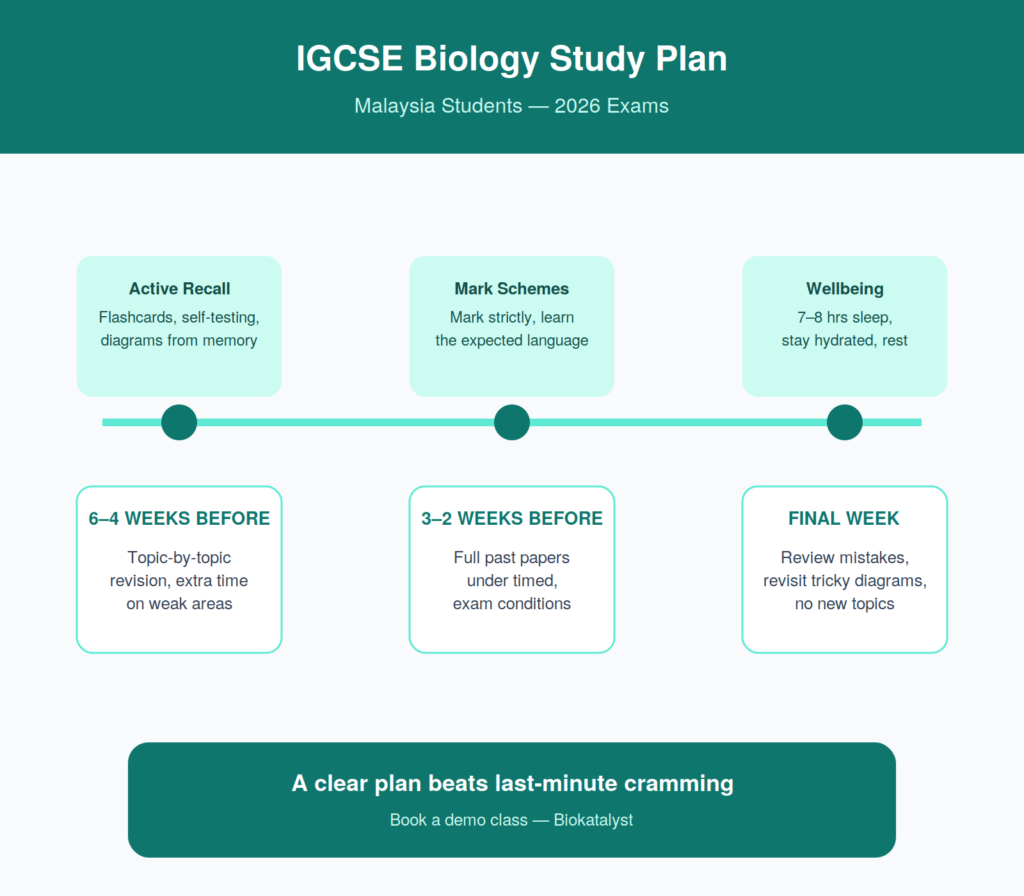
- Six to four weeks before exams: complete topic-by-topic revision, focusing extra time on weaker areas.
- Three to two weeks before exams: work through full past papers under timed conditions.
- Final week: review common mistakes, revisit tricky diagrams, and avoid starting anything new.
This structure keeps the final stretch calm and purposeful, rather than a last-minute scramble through the entire syllabus.
Step 8: Look After Your Wellbeing During Revision
Long revision hours without proper rest tend to backfire, especially in the humid Malaysian climate where fatigue can build up quickly. Sleep, food, and short breaks all play a real role in memory and focus during exam season.
A few habits that genuinely help:
- Aim for seven to eight hours of sleep, particularly in the days leading up to an exam.
- Take a short break every hour of focused study.
- Avoid starting new topics the night before an exam.
- Stay well hydrated throughout the day.
A calm, well-rested mind consistently outperforms an exhausted one, regardless of how many extra hours the exhausted one manages to put in.
Frequently Asked Questions
1. How many hours should I revise IGCSE biology daily?
Two to three focused hours a day works well, spread consistently across several weeks. Quality of revision matters far more than the total hours logged.
2. Is IGCSE biology in Malaysia the same as in other countries?
Yes, IGCSE biology follows the same CIE or Edexcel syllabus internationally, so students in Malaysia sit the same exams and are assessed against the same standards as students elsewhere.
3. When should I start revising for IGCSE biology exams?
Ideally, start at least three to four months before your exams. This gives enough time to cover the full syllabus and still leave room for past paper practice.
4. How can biology tuition in Malaysia help with IGCSE revision?
A good tutor quickly identifies weak topics and guides focused, personalised practice around them, rather than repeating a generic revision plan meant for every student.
5. What are the most difficult topics in IGCSE biology?
Genetics, the human nervous system, and homeostasis tend to feel the trickiest for most students. Regular practice with clear explanations makes these far more manageable over time.
6. How many past papers should I attempt before exams?
Aim for at least eight to twelve full past papers, spread across your final six to eight weeks of revision, with proper marking and review after each attempt.
7. Can online biology tutors support IGCSE students in Malaysia effectively?
Yes, online tutoring works very well when properly structured. Screen sharing and interactive diagrams make lessons just as personal and effective as in-person tuition.
Final Thoughts
Doing well in IGCSE biology takes a clear plan, not luck. Understand your syllabus thoroughly, revise actively rather than passively, and work through past papers consistently in the lead-up to your 2026 exams. Personal, one-to-one guidance makes this whole journey noticeably smoother for students in Malaysia balancing biology alongside everything else.