
If you are working towards an A or A* in A Level Biology, you are not alone in finding it tough. Across the UAE, students tell us the same thing every exam season: the syllabus feels endless, the questions feel unpredictable, and it is hard to know where to even begin revising. The good news is that A Level Biology responds very well to a structured plan. With the right approach, most of that stress disappears.
Why A Level Biology Feels Overwhelming for UAE Students
A Level Biology is content heavy. Two years of topics build on each other, and by the time exams arrive, students are expected to hold the entire syllabus in their heads at once. On top of that, many UAE students are managing school, tuition for multiple subjects, extracurriculars, and university applications all at the same time. Without a plan, revision becomes scattered, and scattered revision rarely leads to top grades.
I am Karishma, co-founder of Biokatalyst, along with my partner Khushbu. Together we bring 13 years of experience teaching biology in Cambridge schools and online, along with several teaching awards between us. The strategy below is built from what we have seen actually move students from a B or C grade to an A or A* in A Level Biology.
Step 1: Know Your Syllabus Inside Out
Before touching a revision guide, sit down with the actual syllabus document. It tells you exactly what you are responsible for knowing, and just as importantly, it shows the command words examiners use, such as describe, explain, compare, and evaluate. A huge number of marks are lost not because students don’t know the biology, but because they misread what the question is actually asking.
Keep a printed copy of the syllabus close by during revision. Tick off each topic as you work through it. This one habit does two things: it keeps your revision on track, and it gives you a visible sense of progress, which matters a lot in a subject this large.
Step 2: Build a Realistic A Level Biology Revision Timetable
A strong revision timetable spreads topics across weeks rather than cramming them into a few days. For a content-heavy subject like A Level Biology, cramming almost never works, because the depth of understanding required simply cannot be built overnight.
A simple approach that works well:
- List every topic from the syllabus.
- Mark the topics you personally find most difficult.
- Give harder topics more revision sessions than easier ones.
- Reserve your final two weeks purely for past paper practice.
Short, focused sessions beat long, tiring ones. Thirty to forty minutes per topic, with a proper break in between, keeps your concentration sharp and your retention high.
Step 3: Use Active Recall, Not Just Reading
Reading your notes over and over feels productive, but it rarely helps information stick in the way active recall does. Active recall means testing yourself without looking at your notes, forcing your brain to retrieve information rather than just recognise it.
Methods that genuinely work for A Level Biology:
- Cover your notes and write down everything you remember about a topic.
- Use flashcards for key terms, enzymes, and processes.
- Explain a topic out loud, as though you were teaching a friend or younger student.
- Draw diagrams from memory, then check them against your notes for gaps.
This takes more effort than passive reading, but it is exactly that effort which builds the kind of long-term memory you need to walk into an exam confidently.
Step 4: Practise With Past Papers
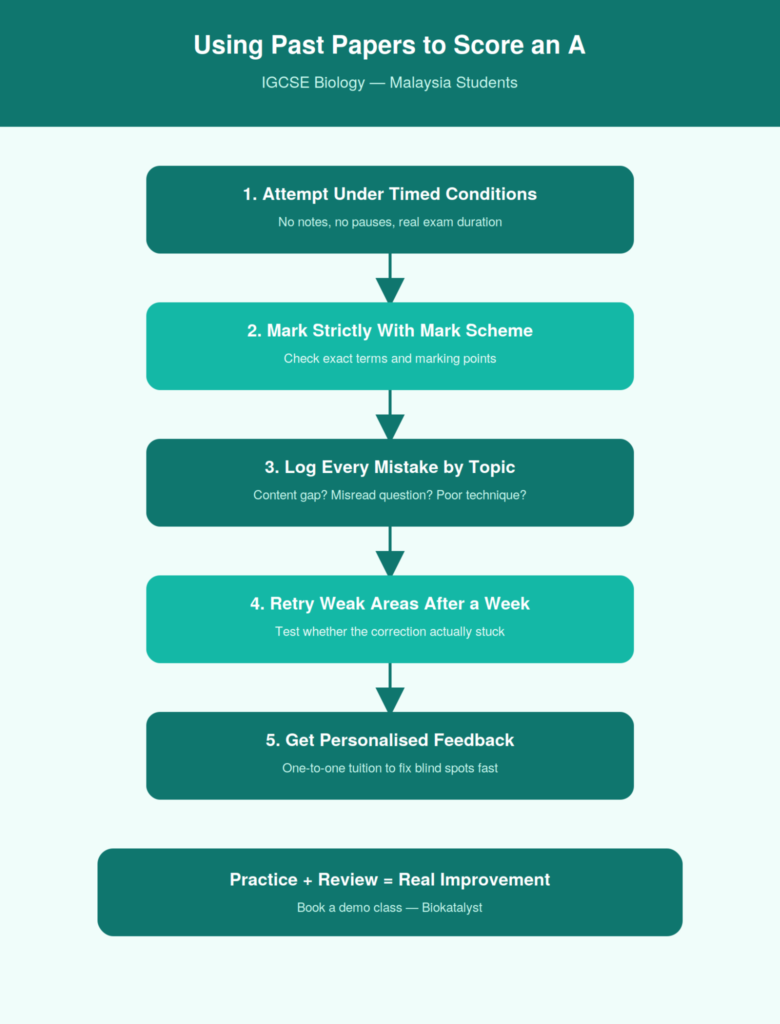
Past papers are one of the most valuable resources available for A Level Biology revision. They show you exactly how examiners phrase questions, and they reveal your weak areas faster than almost anything else.
A useful routine to follow:
| Stage | What to Do |
| First attempt | Answer under timed, exam-style conditions |
| Marking | Mark strictly using the official mark scheme |
| Review | Note down any repeated mistakes or patterns |
| Retry | Redo similar questions again after about a week |
Mark schemes use very specific biology language, and learning to write in that language is often the difference between a B and an A grade. The more past papers you work through properly, the more natural this language becomes.
Step 5: Get One-to-One Support Where You Actually Need It
Every student struggles with different parts of the syllabus. One student finds genetics confusing, another gets stuck on respiration, and someone else can’t quite get their head around nervous coordination. Group classes, by their nature, cannot fully address this, because the pace is set for the average student in the room, not for any one individual.
With one-to-one tuition, doubts get addressed personally and immediately. A tutor can slow right down on the topics that are genuinely difficult for you, and move quickly through the ones you already understand well. This is a big part of why parents tell us their child finally gets help exactly where they need it, instead of sitting through a generic lesson plan built for everyone else in the class.
At Biokatalyst, we teach students directly, with no middleman in between. That means the person planning your lessons is the same person delivering them, giving direct feedback, and tracking your progress across the full syllabus consistently, not occasionally.
Step 6: Focus on Application Questions
Students who score an A* rarely do so on memorised facts alone. They apply their knowledge to unfamiliar situations, and A Level Biology papers are built around exactly this skill. Application questions often present a new organism, a novel experiment, or an unfamiliar dataset, and expect you to reason through it using biology principles you already know.
Practise these questions regularly, and get in the habit of asking yourself why an answer is correct, not just what the answer is. This shift, from memorising outcomes to understanding reasoning, is what separates the students who hit an A from the ones who reach an A*.
Step 7: Look After Your Wellbeing Too
Long hours of revision without proper rest tend to backfire. Sleep, food, and short breaks all play a direct role in memory consolidation and focus, both of which you need in large supply during exam season.
A few habits that genuinely help:
- Aim for seven to eight hours of sleep, especially in the days before an exam.
- Take a short, ten-minute break every hour of focused study.
- Avoid starting brand new topics the night before an exam.
- Stay well hydrated, particularly during the warmer months in the UAE.
A calm, rested mind consistently outperforms an exhausted one, no matter how many extra hours the exhausted one puts in.
Frequently Asked Questions
1. How many hours should I revise A Level Biology daily? Two to three focused hours a day works well, as long as it is spread consistently across several weeks. The quality of your revision matters far more than the total number of hours logged.
2. Is A Level Biology harder than IGCSE Biology? Yes. A Level Biology goes significantly deeper into each topic and expects more detailed, application-based answers rather than straightforward recall.
3. When should I start revising for A Level Biology exams? Ideally, start at least four to six months before your exams. This gives you enough time to cover the full syllabus properly and still leave room for past paper practice.
4. How can a biology tutor in Dubai help with my revision? A good biology tutor in Dubai will quickly identify your weak topics and guide focused, personalised practice around them, rather than repeating a generic, one-size-fits-all revision plan.
5. What are the most difficult topics in A Level Biology? Genetics, respiration, and nervous coordination tend to feel the trickiest for most students. Regular practice paired with clear, step-by-step explanations makes these far more manageable over time.
6. How many past papers should I attempt before my exams? Aim for at least ten to fifteen full past papers, spread across your final two months of revision, with proper marking and review after each one.
7. Can online biology tutors help UAE students as effectively as in-person tutors? Yes. Online tutoring works very well when it is properly structured, and tools like screen sharing and interactive whiteboards make lessons just as personal and effective as sitting in a room together.
8. How do I improve my A Level Biology essay-style answers? Focus on using command words correctly and structuring your points clearly. Practising regularly against official mark schemes steadily sharpens this skill.
Final Thoughts
Scoring an A or A* in A Level Biology takes a clear plan, not luck. Know your syllabus thoroughly, revise actively rather than passively, and work through past papers consistently. Personal, one-to-one guidance makes this whole journey noticeably smoother for UAE students juggling biology alongside everything else.