
Ask any top-scoring IGCSE biology student what actually helped them the most, and past papers almost always come up first. Yet many students in Malaysia still use biology IGCSE past papers the wrong way, working through them without a clear method, then wondering why their marks are not improving as fast as they hoped. Here is a step-by-step guide to using IGCSE biology past papers properly, built for students aiming for an A or A*.
Why IGCSE Biology Past Papers Matter So Much
IGCSE biology exam practice is not just about testing what you know. Past papers reveal exactly how examiners phrase questions, which command words appear most often, and where marks are genuinely won or lost. No revision guide can replicate this as accurately as real exam papers can.
I am Karishma, co-founder of Biokatalyst, along with my partner Khushbu. Together we bring 13 years of experience teaching biology in Cambridge schools and online, along with several teaching awards between us. We work with IGCSE biology students across Malaysia on both the CIE and Edexcel syllabuses, and the method below reflects what we have consistently seen move students from a B grade to an A or A*.
Step 1: Start With Topic-Wise Past Papers, Not Full Papers
Before attempting full exam papers, work through IGCSE biology past papers organised by topic. Many past paper collections are broken down this way, allowing you to practise questions on a single topic, such as respiration or the nervous system, right after you finish revising it.
This approach reinforces what you have just learned while it is still fresh, and it makes weak spots obvious immediately rather than weeks later. Save full timed papers for later in your revision, once most topics have been covered at least once.
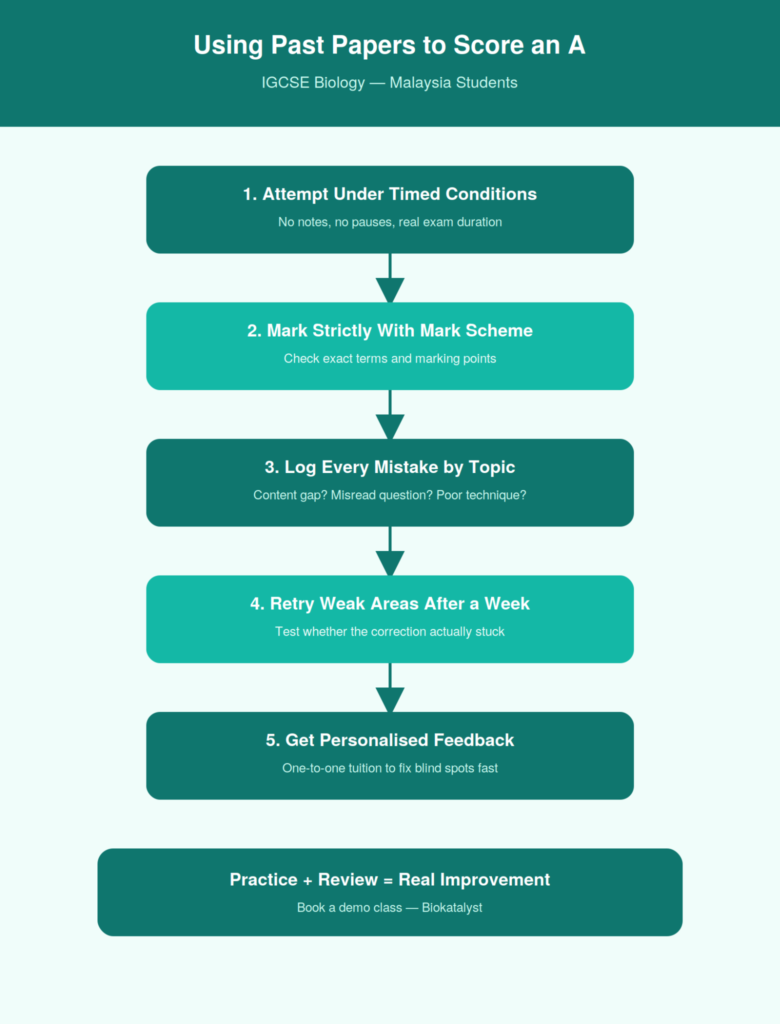
Step 2: Attempt Questions Under Real Exam Conditions
Once you move on to full past papers, treat every attempt as seriously as the real exam. This means:
- Sitting the paper in one sitting, without pausing to check notes.
- Timing yourself strictly, using the actual exam duration.
- Working in a quiet space, free from distractions like your phone.
- Using only the resources allowed in the real exam.
Students who practise casually, checking notes mid-paper or stopping partway through, rarely build the stamina and pacing needed for the real thing. Treating practice seriously from the start makes exam day feel far more familiar.
Step 3: Mark Strictly Using the Official Mark Scheme
This is the step most students rush, and it is also the step that matters most. After attempting a paper, mark it yourself using the official mark scheme, and mark it honestly rather than generously.
A few things to pay close attention to while marking:
- Whether you used the exact biological terms the mark scheme expects.
- Whether you missed marking points even when your overall answer was broadly correct.
- Whether you lost marks for vague or generic phrasing instead of specific biology.
- Whether command words like “describe” and “explain” were answered appropriately.
Mark schemes use very specific biology language, and learning to recognise the gap between your answer and the expected answer is where the real improvement happens.
Step 4: Keep a Mistake Log Across Multiple Papers
A single past paper tells you what went wrong once. A mistake log, built up across several papers, tells you what is going wrong repeatedly, which is far more useful.
After marking each paper, note down:
- The topic each lost mark belonged to.
- Whether the mistake was a content gap, a misread question, or poor exam technique.
- Any command word you consistently misunderstand.
Over time, clear patterns emerge. Perhaps genetics questions keep costing marks, or perhaps you consistently under-explain “explain” questions. This log becomes your most personalised revision resource, far more targeted than any generic guide.
Step 5: Retry Weak Question Types After a Short Gap
Once you have identified weak areas from your mistake log, revisit similar questions from other past papers after about a week, rather than immediately. This gap allows you to test whether the correction has actually stuck, rather than just remembering the specific question you got wrong the first time.
If a mistake still keeps recurring after a retry, that topic needs focused revision, not just more question practice. This is often where one-to-one biology tuition in Malaysia becomes particularly useful, since a tutor can quickly identify why a specific concept isn’t clicking and address it directly.
Step 6: Compare Answers Across Different Exam Sessions
IGCSE biology past papers Malaysia students use often span several exam sessions and years. Working through papers from different sessions, rather than repeating the same one or two papers, exposes you to a wider range of question styles and phrasing.
This is particularly useful for application-based questions, which often use unfamiliar contexts, such as a new organism or an unusual experiment. The more varied your past paper exposure, the less thrown you will be by an unfamiliar scenario on exam day.
Step 7: Use Past Papers to Practise Data and Diagram Questions Specifically
IGCSE biology places significant weight on graphs, tables, and diagram-based questions, and these often catch students out more than content-based questions do. Set aside dedicated past paper sessions purely for data interpretation and diagram labelling, separate from your general topic practice.
Pay close attention to:
- Reading axes and units correctly on graphs.
- Describing trends using appropriate biological language.
- Labelling diagrams precisely, using exact terminology from the syllabus.
This kind of focused practice builds a specific skill set that general topic revision alone does not fully cover.
Step 8: Get Personalised Feedback Through Biology Tuition in Malaysia
Self-marking is valuable, but it has limits. It is genuinely difficult to spot your own blind spots, especially around exam technique and answer structure. This is where biology tuition in Malaysia adds real value, since a tutor can review your past paper answers, explain exactly why marks were lost, and correct patterns you might not notice on your own.
At Biokatalyst, we teach students directly, with no middleman in between, going through past paper answers line by line where needed. This means doubts get addressed the moment they come up, not left unresolved until the next test result.
A Simple Past Paper Practice Schedule
For students unsure how to fit past paper practice into their existing revision, a simple structure looks like this:
| Timeframe | Focus |
| 8–6 weeks before exams | Topic-wise past paper questions after each topic |
| 5–3 weeks before exams | Full timed past papers, one to two per week |
| Final 2 weeks | Review mistake log, retry weak question types |
This keeps past paper practice consistent throughout your revision, rather than crammed into the final few days before your exam.
Frequently Asked Questions
1. How many IGCSE biology past papers should I complete before exams? Aim for at least eight to twelve full past papers, spread across your final two months of revision, alongside topic-wise practice earlier on.
2. Where can I find reliable IGCSE biology past papers in Malaysia? Official past papers are available through CIE and Edexcel exam board websites, and many tuition providers, including Biokatalyst, also organise these by topic for easier practice.
3. Should I time myself for every past paper attempt? Yes, especially closer to exams. Timed practice builds the pacing and exam stamina needed to complete the real paper comfortably within the time given.
4. How do I know if I am marking my own papers accurately? Compare your marking closely against the official mark scheme, and where possible, have a tutor review a few papers to check you are marking consistently and honestly.
5. Are past papers from older exam sessions still useful? Yes, older past papers remain useful for building familiarity with question styles, though it is worth prioritising more recent sessions as they better reflect current examiner trends.
6. How can a biology tutor in Malaysia help with past paper practice specifically? A tutor can review your answers, identify recurring mistakes in your mistake log, and explain exactly what the mark scheme expected, helping you fix patterns faster than working alone.
7. What should I do if I keep making the same mistake across papers? Treat this as a signal that the underlying concept needs revisiting, not just more question practice. Focused revision on that specific topic, ideally with guided feedback, usually resolves it faster.
Final Thoughts
Using IGCSE biology past papers effectively is less about how many you complete and more about how carefully you review each one. Practise under real conditions, mark honestly, track your mistakes, and revisit weak areas with intention. Personal, one-to-one guidance makes this process far more effective for Malaysia students working towards an A or A* in IGCSE biology.