
Looking for IGCSE biology notes that are short and easy to follow? This guide gives you free quick notes for key topics. You also get simple study tips to revise with less stress.
How to Use These IGCSE Biology Notes
These notes are a quick revision tool. They are not a replacement for your textbook.
Use them in three steps. Read one topic. Close the page. Write what you remember.
This is called active recall. It works better than reading again and again. I have seen this with my own students for 13 years.
Your exam board may be Cambridge or Edexcel. The topics are very similar. Always check your own syllabus for small changes.
What Topics Are in IGCSE Biology?
The course has about 20 topics. They fit into a few groups.
| Group | Main Topics |
| Living things | Characteristics, classification, cells |
| Body processes | Enzymes, nutrition, respiration, transport |
| Health | Diseases, immunity, drugs |
| Control and life | Coordination, reproduction, inheritance |
| Environment | Ecosystems, human impact, biotechnology |
Start with cells and enzymes. Many other topics depend on them.
Free IGCSE Biology Notes: Quick Topic Summaries
Characteristics of Living Things
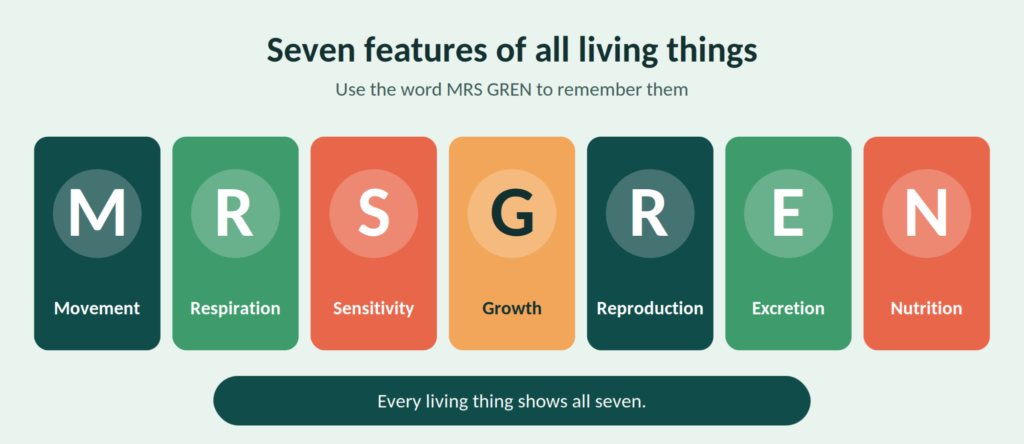
All living things show seven features. Use the word MRS GREN to remember them.
- Movement
- Respiration
- Sensitivity
- Growth
- Reproduction
- Excretion
- Nutrition
Cells and Movement of Substances
Plant cells have a cell wall, chloroplasts and a large vacuole. Animal cells do not.
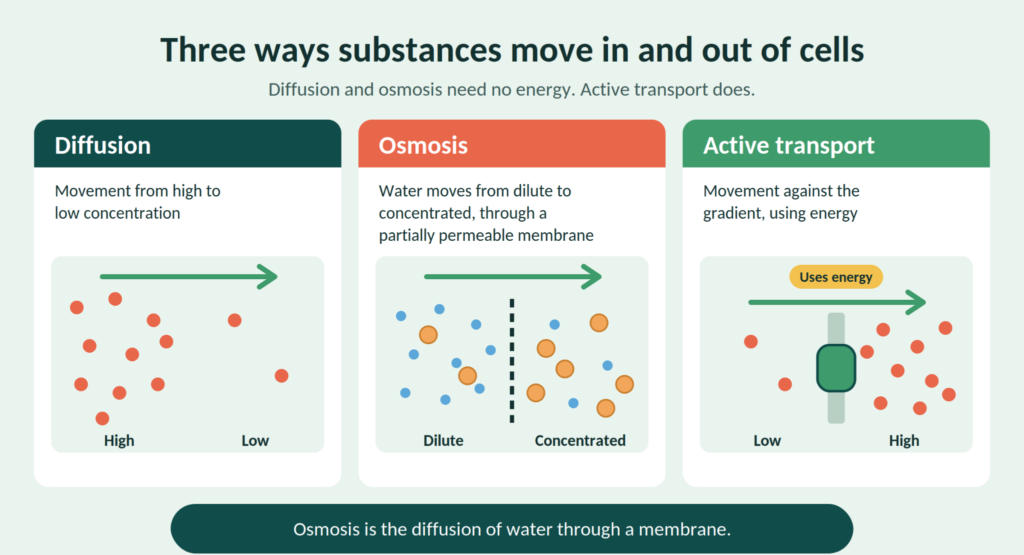
Three ways substances move in and out of cells:
- Diffusion: movement from high to low concentration.
- Osmosis: water moves from a dilute solution to a concentrated one, through a partially permeable membrane.
- Active transport: movement against the gradient, using energy.
Enzymes
Enzymes are proteins. They speed up reactions in living things.
Each enzyme fits only one substrate, like a lock and key. High temperature changes the enzyme shape. We say the enzyme is denatured. It then stops working.
Biological Molecules and Food Tests
Know these four tests well. They appear very often.
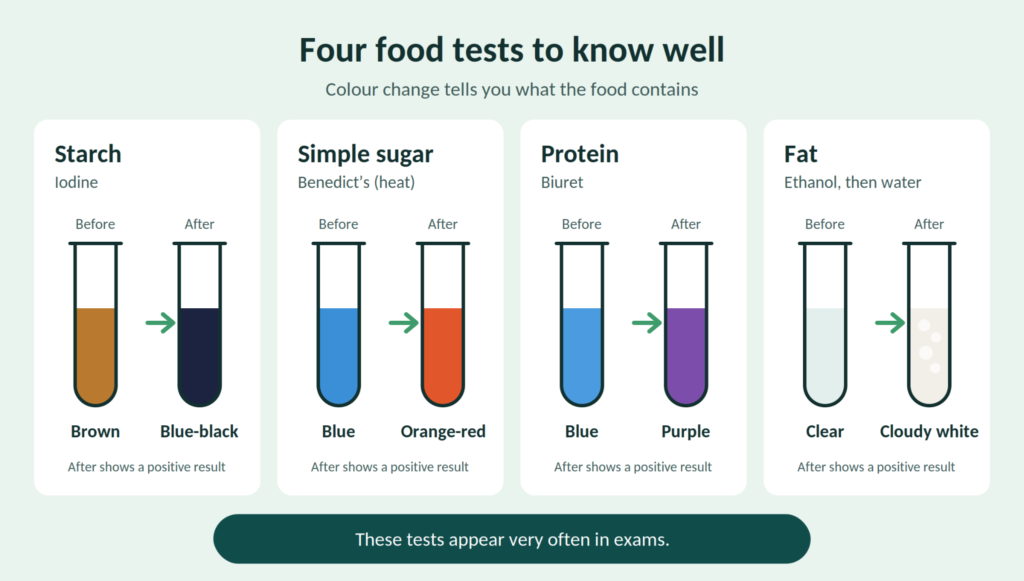
| Test | Chemical | Positive Result |
| Starch | Iodine | Brown to blue-black |
| Simple sugar | Benedict’s (heat) | Blue to orange-red |
| Protein | Biuret | Blue to purple |
| Fat | Ethanol, then water | Cloudy white layer |
Photosynthesis and Respiration
Plants make food using light. Learn both word equations.
- Photosynthesis: carbon dioxide + water → glucose + oxygen (needs light and chlorophyll)
- Aerobic respiration: glucose + oxygen → carbon dioxide + water + energy
Respiration happens in every living cell, all day. It is not the same as breathing
.
Inheritance
Genes are short sections of DNA. They carry instructions for traits.
Learn these key words:
- Genotype: the genes you have.
- Phenotype: the trait you can see.
- Dominant: shows even with one copy.
- Recessive: shows only with two copies.
Practise Punnett squares daily. After a week, they feel easy.
Ecosystems and Human Impact
Energy flows from the Sun to producers, then to consumers. Only a small part passes to the next level.
Humans affect the environment through deforestation, pollution and overfishing. Always link the cause to the effect in your answer.
Study Tips for IGCSE Biology Revision
Good notes help only if you use them well. Try these habits:
- Make a revision plan. Give each topic a date.
- Draw diagrams from memory. Heart, leaf, kidney and eye are common.
- Use flashcards. Put key terms on one side and meanings on the other.
- Practise past papers. Start after each topic, not at the end.
- Read the mark scheme. Learn the exact words examiners expect.
- Learn command words. “State,” “describe” and “explain” need different answers.
- Ask for help early. Small doubts become big gaps.
Common Mistakes When Using Notes
Avoid these traps:
- Copying notes without understanding them.
- Highlighting everything in bright colours.
- Skipping topics that feel hard.
- Memorising definitions without examples.
- Not testing yourself after revision.
Notes should make Biology simpler. If they feel confusing, you may need a teacher to explain the topic.
When Notes Are Not Enough
Sometimes a student reads the notes five times and still feels lost. This is normal.
Notes cannot answer your questions. They cannot see where you are stuck. A teacher can.
That is where one-to-one help makes a real difference. The class moves at your pace and starts where you need it.
How We Help at Biokatalyst
I am Karishma, founder of Biokatalyst. My partner Khushbu and I have 13 years of experience teaching in Cambridge schools and online. We have also received several awards for our teaching work.
We teach students directly, with no middleman. Every class is built around one student.
We find weak topics first. Then we fix them step by step. Parents stay updated, and students feel more confident before exams.
FAQs
1. Where can I find free IGCSE biology notes?
Many websites and school portals share free notes. Choose notes that match your exam board and syllabus code.
2. Are IGCSE biology notes enough to score well?
Notes help with revision. You also need past paper practice and a clear understanding of each topic.
3. How many topics are in IGCSE Biology?
There are about 20 topics. The exact number depends on your exam board and syllabus year.
4. How should I make my own biology notes?
Keep them short. Use headings, small diagrams and key terms. Add one example for each idea.
5. Which topics are hardest in IGCSE Biology?
Many students find genetics, enzymes and transport tricky. Slow, regular practice helps a lot.
6. How early should I start revising?
Start at least three to four months before exams. Revise each topic a little every week.
7. Are Cambridge and Edexcel notes the same?
Most content is similar. Some points and question styles differ, so check your syllabus.
8. Can a tutor help if I already have notes?
Yes. A tutor explains confusing topics and checks your understanding. This makes your notes easier to use.
Conclusion
Good IGCSE biology notes are short, clear and easy to revise. Read a topic, test yourself, then fix the gaps. Add past papers and diagram practice to your routine.
If a topic still feels confusing, ask for help early. A little support now saves a lot of stress later.
See how one-to-one Biology feels. Book a free demo class with Biokatalyst.