
Stuck on a B in A Level Biology? You know the content, yet marks still slip away. The gap between a B and an A* is smaller than you think. This guide shows you how to close it.
Why Students Get Stuck at a B in A Level Biology
A B grade means you understand most of the course. So the problem is rarely effort.
Most students at this level lose marks in the same few places. They give answers that are almost right. They miss one key word. They freeze on questions that look new.
In my 13 years of teaching, I have seen this pattern again and again. The good news is that every one of these habits can be fixed.
Here are signs you are stuck at a B:
- You score well on recall questions but lose marks on application.
- You know the topic but write vague answers.
- Graph and data questions take too long.
- You run out of time in long answers.
- You repeat the same mistakes in past papers.
If two or three of these feel familiar, keep reading.
What Makes an A* Different in A Level Biology?
An A* student is not always the smartest in class. They simply use their marks more carefully.
They do three things well:
- They answer the exact question. They read the command word and stay on topic.
- They use precise terms. They say “complementary base pairing,” not “the bases match.”
- They link ideas. They connect topics like enzymes, respiration and transport.
A Level Biology rewards clear thinking more than long answers.
A Simple Study Plan: Moving from B to A*
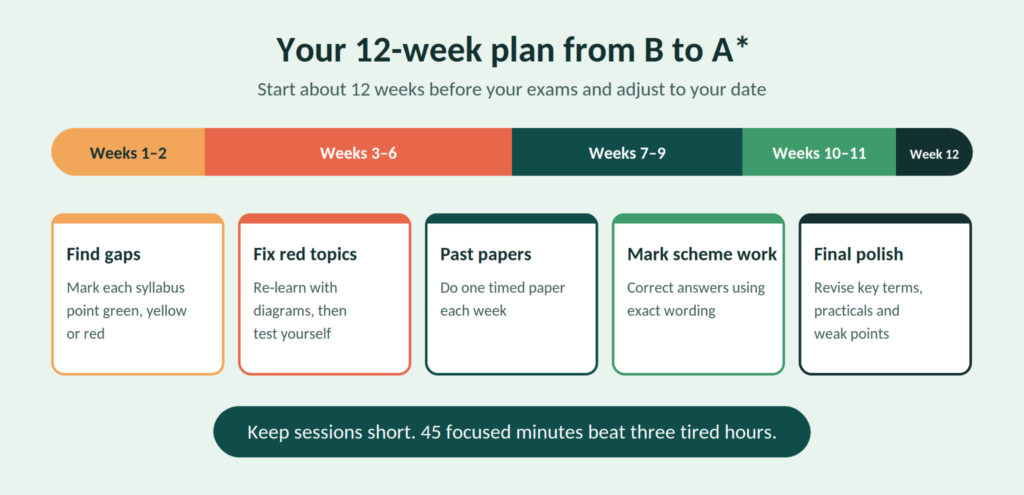
Start this plan about 12 weeks before your exams. Adjust it to your exam date.
| Weeks | Focus | What to Do |
| 1–2 | Find gaps | Mark each syllabus point as green, yellow or red |
| 3–6 | Fix red topics | Re-learn with diagrams, then test yourself |
| 7–9 | Past papers | Do one timed paper each week |
| 10–11 | Mark scheme work | Correct answers using exact wording |
| 12 | Final polish | Revise key terms, practicals and weak points |
Keep sessions short. Forty-five minutes of focused work beats three tired hours.
Step 1: Use Your Syllabus as a Checklist
Download your syllabus from your exam board. Tick off each point honestly.
Red topics need the most time. Do not avoid them. Most extra marks hide there.
Step 2: Learn Through Active Recall
Reading notes again feels productive. It is not.
Instead, close the book. Write everything you know on a blank page. Then check what you missed.
Step 3: Practise Past Papers the Smart Way
Do not rush through papers. Use each one as a learning tool.
After marking, ask three questions. Why did I lose this mark? What word was missing? How will I fix it next time?
Keep a mistake log. Review it every week.
Common Mistakes in A Level Biology
These errors cost students marks every year.
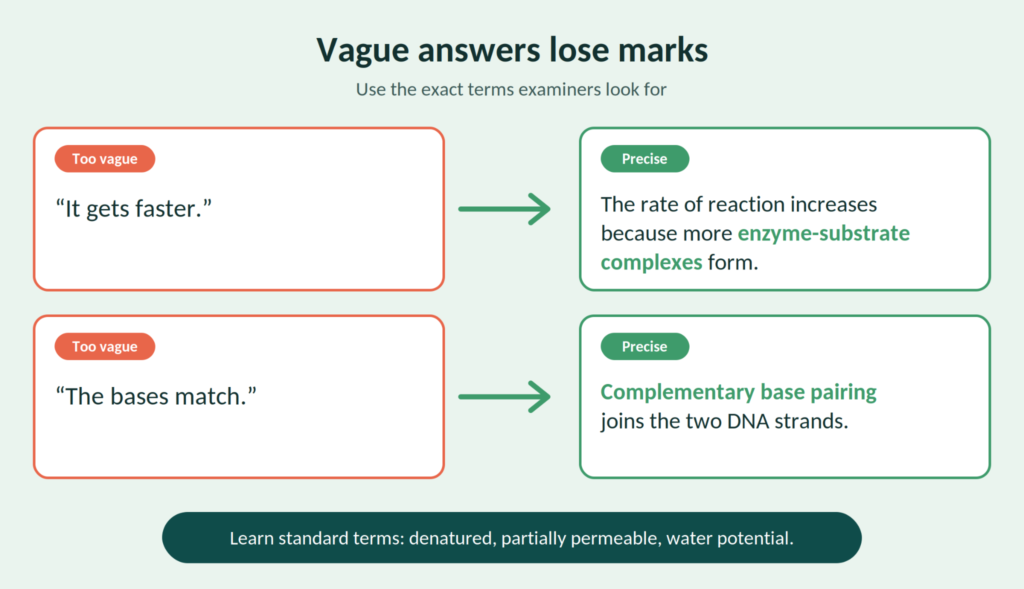
- Writing vague answers. “It gets faster” earns nothing. “The rate of reaction increases because more enzyme-substrate complexes form” earns marks.
- Ignoring command words. “Describe” and “explain” need different answers.
- Skipping practical skills. Planning, variables and evaluation carry many marks.
- Not using data. When a question gives numbers, quote them in your answer.
- Leaving gaps in basics. Weak foundations show up in harder topics.
- Memorising without understanding. New contexts will expose this quickly.
Fix one mistake at a time. Small changes add up.
Examiner Tips for A Level Biology
Think like the person marking your paper. They follow a mark scheme with set points.
Match Your Answer to the Marks
A 3-mark question needs three clear points. Write one point per line. This makes marking easy.
Use Key Terms Exactly
Mark schemes look for precise words. Learn the standard terms for each topic. Examples include “denatured,” “partially permeable” and “water potential.”
Handle Data Questions Calmly
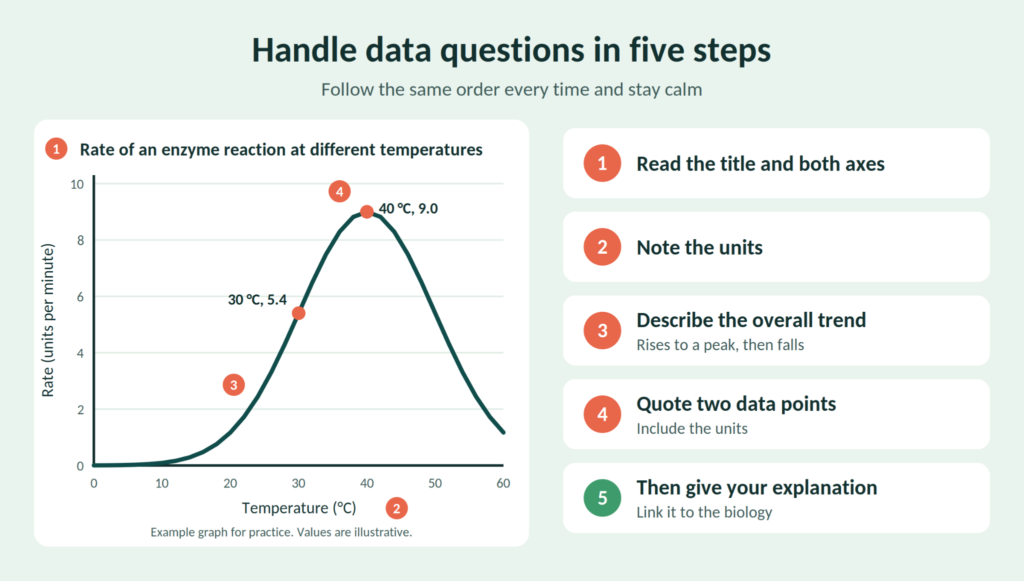
For graphs, follow this order:
- Read the title and both axes.
- Note the units.
- Describe the overall trend.
- Quote two data points with units.
- Then give your explanation.
Practise Long Answers
Plan before you write. Jot three or four key points first. Then write in a clear order. This keeps your answer focused.
Stay Calm With Unfamiliar Questions
Some questions use topics you have never seen. Do not panic. They still use ideas from your course. Break the question into small parts and use what you know.
How We Help at Biokatalyst
I am Karishma, founder of Biokatalyst. My partner Khushbu and I have 13 years of experience teaching in Cambridge schools and online. We have also received several awards for our teaching work.
We teach students directly, with no middleman. Every class is one-to-one.
We look at your past paper answers and find where marks are lost. Then we fix those habits step by step, at your pace. Parents also get regular updates.
FAQs
1. Can I really go from a B to an A in A Level Biology?*
Many students improve by one or two grades. It needs steady practice, honest feedback and good exam technique.
2. How long does it take to improve my grade?
Most students need two to three months of focused work. Starting earlier gives you more room to fix gaps.
3. How many hours should I study each week?
Aim for five to eight hours of focused study. Quality matters more than long hours.
4. How many past papers should I do?
Do as many as you can, ideally all recent ones. Mark each carefully and learn from every mistake.
5. Which A Level Biology topics are the hardest?
Many students find genetics, energy and respiration, and homeostasis difficult. Regular practice makes them easier.
6. Are practical skills important in A Level Biology?
Yes. Practical skills carry a good share of marks. Practise planning, graphs and evaluating experiments.
7. Should I memorise the mark scheme?
Do not memorise it. Study it to learn the wording and level of detail examiners expect.
8. When should I get a tutor?
Get help when marks stop improving or topics feel confusing. Early support saves time and stress.
Conclusion
Moving from a B to an A* in A Level Biology is about small, steady changes. Find your weak topics. Practise with past papers. Use exact words and answer the exact question.
Keep a mistake log and learn from it each week. With the right plan, A Level Biology becomes clearer and more manageable.
Book a demo class with Karishma and Khushbu. We are online biology tutors for A Level students.