
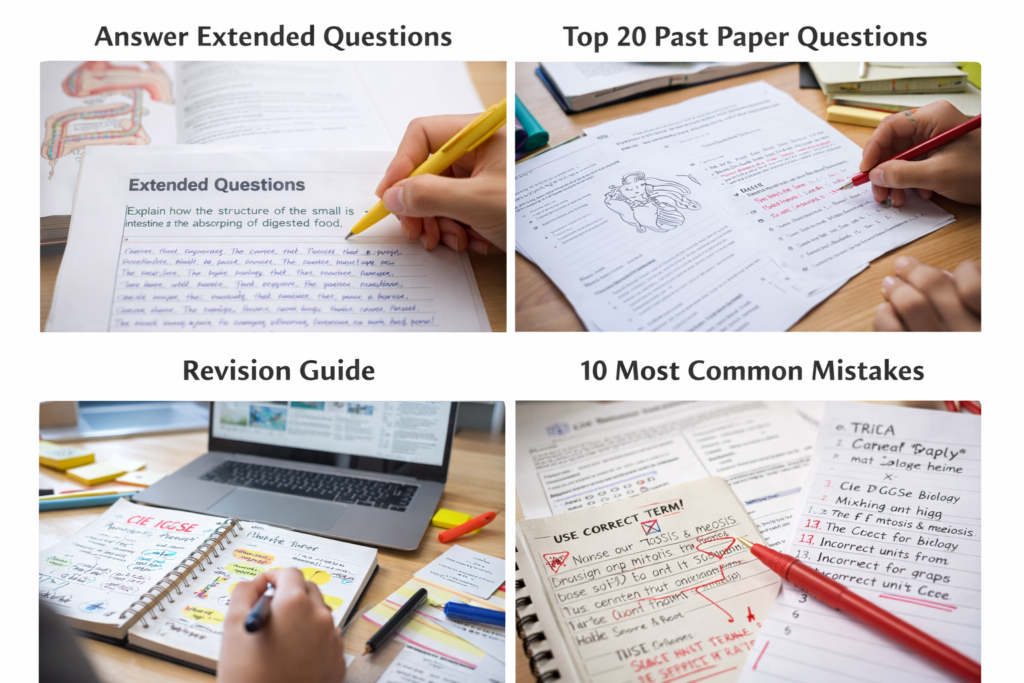
CIE IGCSE Biology Paper 4: How to Answer Extended Questions (With Sample Answers)
Most students lose marks not because they don’t know Biology — but because they don’t know how to write answers. Paper 4 has a specific way it wants you to respond. Learn that, and your marks will go up. This guide shows you exactly how, with real sample answers.
What Is CIE IGCSE Biology Paper 4?
Paper 4 is the written theory paper for extended level students. It carries a lot of marks, so doing well here makes a real difference to your final grade.
The questions are longer here. They test whether you can explain, compare, and apply what you know. One-word answers will not work in this paper. You need to write in full, connected sentences.
Most students find Paper 4 harder than Paper 2. Not because the Biology is harder — but because the answers need more thought and structure.
Why Do Students Lose Marks in Paper 4?
Before we look at how to answer well, let us look at why marks get lost.
These are the most common reasons:
Vague answers — Writing “it increases” without saying what increases or by how much.
Missing key words — CIE mark schemes look for specific Biology terms. If you say “particles move” instead of “molecules diffuse,” you may not get the mark.
Not reading the command word — “Describe” and “explain” are not the same thing. Mixing them up costs marks every time.
Writing too much of the wrong thing — A 2-mark question needs two marking points, not a paragraph of general facts.
Repeating the question — Starting your answer by restating what was asked wastes time and adds nothing.
Understand the Command Words First
CIE uses specific command words in every question. These tell you exactly what kind of answer is expected. Getting this wrong is one of the biggest reasons students underperform in Paper 4.
Here are the ones that come up most often:
State — Give a fact. Short and direct. No explanation needed. Example: State the products of aerobic respiration. Answer: Glucose and oxygen. ❌ Wrong direction — Carbon dioxide and water.
Describe — Say what happens. Give details of a process or pattern. Still no “why” needed. Example: Describe what happens to heart rate during exercise. Answer: Heart rate increases as exercise intensity increases.
Explain — Say what happens AND why it happens. This is where most marks are lost. You must give a reason. Example: Explain why heart rate increases during exercise. Answer: Muscles need more oxygen for aerobic respiration. The heart beats faster to deliver more oxygenated blood to the muscles.
Compare — Give both similarities and differences. Always mention both sides. A common mistake is only writing about one thing.
Suggest — You may not have been taught the exact answer. Use your Biology knowledge to give a sensible reason.
Calculate — Show your working. Even if your final answer is wrong, working can earn marks.
How to Structure a Paper 4 Answer
Most extended answers in Paper 4 follow a simple pattern. Once you know the pattern, answering becomes much easier.
Step 1 — Identify the command word. Is it describe, explain, compare, or suggest? This tells you the shape of your answer.
Step 2 — Count the marks. A 4-mark question needs four separate marking points. Write one clear point per mark. Do not write one long sentence hoping it covers everything.
Step 3 — Use Biology keywords. Every topic has specific words the mark scheme looks for. Use them. Do not replace “diffusion” with “movement.” Do not replace “enzyme” with “chemical.”
Step 4 — Link your points. Use connecting words — “because,” “therefore,” “this means that,” “as a result.” This shows the examiner you understand the connection between ideas.
Step 5 — Do not repeat yourself. Say each point once, clearly. Repeating the same point in different words does not earn a second mark.
Sample Extended Questions With Model Answers
These are the types of questions that come up in CIE IGCSE Biology Paper 4. Read the question, try it yourself, then compare with the model answer.
Question 1 — Respiration (6 marks) Describe the differences between aerobic and anaerobic respiration in humans.
Model Answer: Aerobic respiration uses oxygen. Anaerobic respiration does not use oxygen. Aerobic respiration produces carbon dioxide and water as products. Anaerobic respiration in humans produces lactic acid. Aerobic respiration releases much more energy per glucose molecule. Anaerobic respiration releases a small amount of energy. Aerobic respiration can continue for a long time. Anaerobic respiration only happens for a short period, as lactic acid builds up and causes fatigue.
What made this answer good: Each sentence makes one clear point. Biology keywords are used throughout. Both sides of the comparison are covered every time.
Question 2 — Transport in Plants (4 marks) Explain how water moves from the soil into the root hair cells.
Model Answer: The soil water has a higher water potential than the inside of the root hair cell. Water moves into the root hair cell by osmosis. Osmosis is the movement of water molecules across a partially permeable membrane. Water moves from a region of higher water potential to a region of lower water potential.
What made this answer good: The direction of movement is explained. The word “osmosis” is used correctly. The reason for movement — water potential difference — is clearly stated. Four points, four marks.
Question 3 — Hormones (5 marks) Explain how insulin controls blood glucose levels after a meal.
Model Answer: After a meal, blood glucose levels rise. The pancreas detects this rise and releases insulin into the blood. Insulin travels to the liver and muscle cells. It causes these cells to take up more glucose from the blood. The liver converts the excess glucose into glycogen for storage. As a result, blood glucose levels fall back to the normal level.
What made this answer good: The answer follows the sequence of events in the correct order. Each step links to the next. Key words — insulin, pancreas, glycogen, liver — are all present. The answer ends with the outcome, completing the loop.
Question 4 — Ecology (3 marks) Suggest why the number of foxes in an area decreases when the rabbit population falls.
Model Answer: Rabbits are the main food source for foxes. When rabbit numbers fall, foxes have less food available. Foxes cannot get enough energy to survive and reproduce, so the fox population decreases.
What made this answer good: The word “suggest” means you apply your knowledge to an unfamiliar situation. The answer gives a clear cause and effect chain. Three marks, three points.
Question 5 — Cell Division (4 marks) Explain why mitosis is important in the human body.
Model Answer: Mitosis produces new cells that are genetically identical to the parent cell. This is important for growth, as the number of body cells increases. Mitosis also replaces old or damaged cells, such as skin cells. It ensures that every new cell contains the correct number of chromosomes — 46 in humans.
What made this answer good: Two functions of mitosis are given — growth and repair. The answer uses “genetically identical” and “chromosomes” — words the mark scheme looks for. Specific detail about chromosome number shows depth of knowledge.
Quick Reference — Paper 4 Dos and Don’ts
Always do this:
- Use the correct Biology keyword for every process
- Write one point per mark
- Answer “why” whenever the question says “explain”
- Cover both sides when a question says “compare”
- Show all working in calculation questions
Never do this:
- Write vague phrases like “it gets better” or “it increases somehow”
- Copy the question back as part of your answer
- Use everyday words when a Biology term exists
- Leave a question blank — a sensible attempt may earn a mark
Who We Are — BioKatalyst
Hi, I am Karishma. I run BioKatalyst with my partner Khushbu. We have been teaching CIE IGCSE Biology for 13 years — first in Cambridge-affiliated schools and now fully online. We have won several teaching awards along the way.
We teach every student ourselves. No assistants, no middlemen, no batch classes. When your child comes to us, they get direct teaching from Karishma or Khushbu — every single session.
Paper 4 is exactly where our students see the biggest improvement. We go through past papers question by question. We show students what the mark scheme is actually looking for. We practise command words until answering them feels natural.
One student came to us getting 40% on Paper 4. After eight weeks of focused sessions, she was scoring above 70%. Not because she suddenly knew more Biology — but because she learned how to write answers the way CIE wants them.
Frequently Asked Questions
How is Paper 4 different from Paper 2? Paper 2 is for core level students and has shorter answers. Paper 4 is for extended level students and requires longer, more detailed responses. It tests deeper understanding and the ability to explain and apply Biology knowledge.
How many marks is CIE IGCSE Biology Paper 4 worth? Paper 4 is worth 80 marks and lasts one hour and fifteen minutes. Every mark matters, so learning how to structure answers is just as important as knowing the content.
What is the best way to prepare for Paper 4? Past papers are the most useful tool. But do not just do them — compare your answers to the mark scheme. Notice the exact words that earn marks. Then practise those answers again from scratch.
My child knows the Biology but still loses marks. Why? This is very common in Paper 4. Knowing the content is not enough. You also need to use the right keywords, respond to the command word correctly, and structure your answer point by point. This is exactly what we work on in our sessions.
Do you cover all topics for Paper 4? Yes. We cover the full CIE IGCSE Biology syllabus across all papers, including Paper 4. We focus especially on the topics and question types that appear most often in exams.
How quickly will my child improve in Paper 4? Most students see a clear improvement within three to four weeks of focused practice. The turning point is usually when they stop writing general facts and start writing targeted, keyword-rich answers.
Book a Free Demo Class
Paper 4 does not have to feel like guesswork. One session with us and your child will understand exactly how to read a question, use the right keywords, and structure an answer that earns full marks.
Book a free demo class with us today. We will look at a past paper question together and show you exactly what the examiner is looking for.
BioKatalyst — Online Biology Tutors | Taught directly by Karishma & Khushbu | 13 Years Experience | CIE IGCSE Specialists