
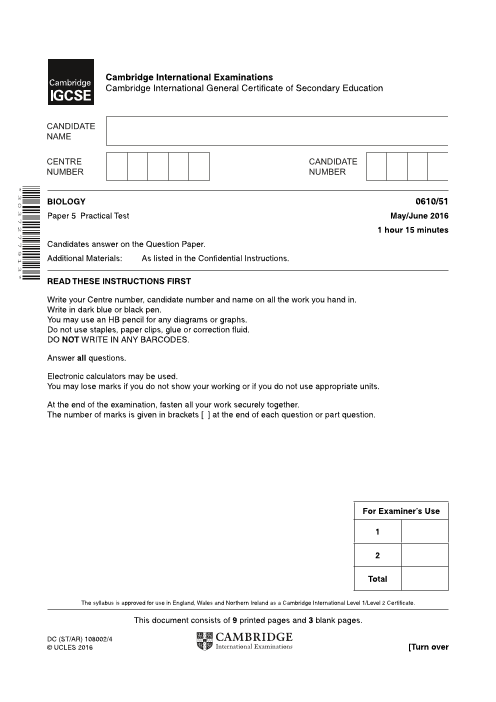
Top 20 CIE IGCSE Biology Past Paper Questions Students Must Practise
Most students read their notes but never practise actual questions. That is exactly why marks get lost on exam day. These 20 questions come from real CIE IGCSE Biology past papers. Work through them before your exam and you will know where you stand.
Why Past Paper Practice Actually Matters
Reading your textbook feels productive. But CIE examiners have a specific way of asking questions. They use particular command words. They expect answers in a certain format. Unless you practise with real past paper questions, you will not recognise these patterns in the exam hall.
Every question below is the type that appears repeatedly across CIE IGCSE Biology papers. Some test memory. Some test understanding. Some test how well you can apply what you know to a new situation. All of them are worth your time.
Cell Biology Questions
Question 1 State two differences between a plant cell and an animal cell.
Model Answer: Plant cells have a cell wall and animal cells do not. Plant cells may contain a permanent vacuole and chloroplasts, which are not found in animal cells.
Why students lose marks: Writing “plants have chlorophyll” instead of “chloroplasts.” The mark scheme wants the organelle, not the pigment.
Question 2 Explain why the cell membrane is described as selectively permeable.
Model Answer: The cell membrane allows some substances to pass through but not others. Small molecules like water and oxygen pass through freely. Larger molecules are blocked or need special transport proteins.
Why students lose marks: Saying “it has holes” — that is not enough. You need to explain that size and type of molecule determine what passes.
Question 3 Describe what happens to a red blood cell placed in pure water.
Model Answer: Water moves into the cell by osmosis. This is because the water potential inside the cell is lower than outside. The cell swells and may burst. This is called lysis.
Why students lose marks: Forgetting to mention osmosis or water potential. Always use the correct scientific term.
Enzymes and Digestion Questions
Question 4 Explain why a high temperature destroys enzyme activity.
Model Answer: High temperatures cause the enzyme to denature. The shape of the active site changes. The substrate can no longer fit into the active site. The enzyme-substrate complex cannot form, so the reaction stops.
Why students lose marks: Writing “the enzyme dies.” Enzymes are not alive. Use the word denature every single time.
Question 5 A student tested a food sample with Benedict’s solution. It turned brick red. What does this tell us?
Model Answer: The food sample contains a reducing sugar. Benedict’s solution turns brick red in the presence of reducing sugars such as glucose.
Why students lose marks: Just writing “sugar is present.” You must state it is a reducing sugar specifically.
Question 6 State the role of bile in digestion.
Model Answer: Bile emulsifies fats. It breaks large fat droplets into smaller ones. This increases the surface area for lipase enzymes to act on. Bile also neutralises stomach acid in the small intestine.
Why students lose marks: Saying bile digests fat. Bile does not contain enzymes. It only emulsifies. Lipase does the actual digestion.
Breathing and Gas Exchange Questions
Question 7 Describe how oxygen moves from the alveoli into the blood.
Model Answer: Oxygen moves by diffusion. The concentration of oxygen is higher in the alveoli than in the blood. Oxygen diffuses across the thin alveolar wall and into the capillaries. It then binds to haemoglobin in red blood cells.
Why students lose marks: Not mentioning the concentration gradient. Diffusion needs a gradient — always state it.
Question 8 Explain why the alveoli are well-suited for gas exchange.
Model Answer: Alveoli have a large surface area for gas exchange. Their walls are one cell thick, so diffusion distance is short. They have a rich blood supply to maintain the concentration gradient. They are moist, which helps gases dissolve.
Why students lose marks: Only stating one feature. This question usually carries three or four marks — you need to give that many points.
Question 9 Compare aerobic and anaerobic respiration in humans.
Model Answer: Aerobic respiration uses oxygen and produces carbon dioxide, water, and a large amount of ATP. Anaerobic respiration does not use oxygen. It produces lactic acid in animals and releases much less energy than aerobic respiration.
Why students lose marks: Forgetting that aerobic respiration produces water as well as carbon dioxide. Both products are needed for the mark.
Blood and Circulation Questions
Question 10 Explain why the left ventricle has a thicker wall than the right ventricle.
Model Answer: The left ventricle pumps blood around the entire body. It needs to generate more pressure than the right ventricle, which only pumps blood to the lungs. A thicker muscular wall creates greater force to push blood the longer distance.
Why students lose marks: Just saying “it pumps harder” without explaining why greater pressure is needed or where the blood goes.
Question 11 Describe the role of platelets in the body.
Model Answer: Platelets help blood clot at the site of a wound. They clump together and trigger a series of reactions. A clot forms to seal the wound and prevent blood loss. The clot also stops pathogens from entering the body.
Why students lose marks: Not mentioning pathogen prevention. CIE mark schemes often want both functions — stopping blood loss and blocking infection.
Question 12 State three ways in which a red blood cell is adapted for carrying oxygen.
Model Answer: Red blood cells have no nucleus, leaving more space for haemoglobin. They have a biconcave disc shape, which increases surface area for oxygen absorption. They are small and flexible so they can squeeze through narrow capillaries.
Why students lose marks: Saying “they contain haemoglobin” as an adaptation. That is what they do, not how they are adapted. The adaptations are the features that help them do it.
Coordination and Senses Questions
Question 13 Describe the path of a nerve impulse in a reflex arc.
Model Answer: A receptor detects the stimulus. The impulse travels along a sensory neurone to the spinal cord. A relay neurone in the spinal cord connects to a motor neurone. The impulse travels along the motor neurone to the effector, which produces a response.
Why students lose marks: Missing the relay neurone. Many students jump straight from sensory to motor. The relay neurone in the spinal cord is always needed.
Question 14 Explain how insulin controls blood glucose concentration.
Model Answer: When blood glucose rises, the pancreas releases insulin. Insulin causes liver and muscle cells to convert glucose into glycogen for storage. This lowers the blood glucose concentration back to normal.
Why students lose marks: Saying insulin “removes” glucose from the blood. It does not remove it — it causes it to be converted and stored. Be precise with your language.
Reproduction and Genetics Questions
Question 15 State two differences between sexual and asexual reproduction.
Model Answer: Sexual reproduction involves two parents and produces offspring with genetic variation. Asexual reproduction involves one parent and produces offspring that are genetically identical to the parent.
Why students lose marks: Writing that asexual reproduction is faster. That may be true, but it is not what CIE mark schemes look for. Stick to the genetic differences.
Question 16 A woman is a carrier for a sex-linked condition. Her partner is unaffected. What is the probability their son will be affected?
Model Answer: The probability is 50% or 1 in 2. The mother carries one faulty allele on one X chromosome. Each son has a 50% chance of inheriting that X chromosome. Sons have only one X chromosome so they cannot be carriers — they will either be affected or unaffected.
Why students lose marks: Giving the answer without showing a Punnett square. Examiners want to see your working, not just a probability number.
Ecology and Environment Questions
Question 17 Explain what is meant by a food chain and give one example from a grassland habitat.
Model Answer: A food chain shows the flow of energy from one organism to another. Each arrow represents energy transfer. An example: grass → grasshopper → frog → hawk. The grass is the producer and uses sunlight to make energy through photosynthesis.
Why students lose marks: Drawing the arrows the wrong way. The arrow always points in the direction energy flows — from eaten to eater.
Question 18 Describe how deforestation affects the carbon cycle.
Model Answer: Trees absorb carbon dioxide during photosynthesis. When trees are cut down and burned, stored carbon is released back into the atmosphere as CO₂. Fewer trees means less CO₂ is removed from the air. This increases the concentration of CO₂ and contributes to the greenhouse effect.
Why students lose marks: Only mentioning one effect. This question usually wants both — less absorption and more release of CO₂.
Question 19 Explain why energy is lost at each stage of a food chain.
Model Answer: Not all energy taken in is passed to the next organism. Some energy is used for the organism’s own respiration. Some is lost as heat. Some is lost in excretion and waste materials. Only the energy stored in body tissue is available to the next level.
Why students lose marks: Saying “energy escapes.” That is too vague. Name the specific ways energy is lost — respiration, heat, excretion. Examiners want named processes.
Disease and Immunity Questions
Question 20 Explain how vaccination protects a person from disease.
Model Answer: A vaccine introduces a weakened or dead form of a pathogen into the body. The immune system responds by producing antibodies. Memory cells are also formed. If the person is exposed to the real pathogen later, the immune system recognises it quickly. Antibodies are produced faster and in greater numbers, so the person does not become ill.
Why students lose marks: Forgetting to mention memory cells. The speed of the second response is due to memory cells — that is what makes vaccination work. Always include them.
How to Use These Questions Properly
Reading these answers is not enough. Here is how to get real benefit from this list.
Cover the model answer first. Write your own answer from memory. Then compare what you wrote against the model answer word by word. Look for missing key terms. Note the command words — “state” wants a short fact, “describe” wants more detail, “explain” wants a reason with a because.
Do this once a week in the weeks before your exam. Your answers will get sharper and your mark scheme awareness will improve with every round.
About BioKatalyst
Hi, I am Karishma. I run BioKatalyst with my partner Khushbu. We have both taught CIE IGCSE Biology for 13 years — inside Cambridge-affiliated schools and online. We have won several teaching awards across our careers.
Every class at BioKatalyst is taught directly by us. No other tutors. No assistants. Your child works with the same teacher every week. We sit with past papers, go through answers question by question, and teach students exactly what the mark scheme is looking for. That is the difference between reading Biology and scoring in Biology.
Frequently Asked Questions
How many past papers should I do before my IGCSE exam? At least five full papers under timed conditions. But quality matters more than quantity. Going through ten papers without reviewing your mistakes will not help as much as doing five papers and carefully checking every wrong answer against the mark scheme.
Which topics come up most in CIE IGCSE Biology papers? Cell biology, enzymes, gas exchange, blood circulation, genetics, and ecology appear consistently. Photosynthesis and respiration are also high-frequency topics. Do not leave any of these out of your revision.
My child knows the content but still loses marks. Why? This is very common. It usually means they are not writing in the format examiners expect. CIE mark schemes look for specific terms, specific sentence structures, and specific command word responses. We practise this directly in our sessions.
Do you do past paper sessions at BioKatalyst? Yes. Past paper practice is a core part of how we teach. We go through questions with students one by one, identify where marks are lost, and teach the correct way to phrase answers. Students see a real difference in their paper scores within a few weeks.
When should my child start practising past papers? Earlier than most students think. Start at least three months before the exam. Use the first papers to identify weak topics. Use the final papers for timed practice closer to the exam date.
Is one-to-one tuition better than group classes for exam practice? For past paper work, yes. Every student drops marks in different places. In a one-to-one session, we focus entirely on what your child is getting wrong. In a group class, that personal attention is not possible.
Book a Free Demo Class With Us
Past papers are one of the fastest ways to improve your IGCSE Biology score. But working through them alone, without knowing what the examiner wants, can still leave you stuck.
Book a free demo class with us. We will look at where your child is losing marks and show them exactly how to answer those questions the way CIE examiners expect.
BioKatalyst — Online Biology Tutors | Taught directly by Karishma & Khushbu | 13 Years Experience | CIE IGCSE Specialists