
Enzymes in CIE IGCSE Biology: Lock-and-Key Model, Factors Affecting Enzyme Activity & Exam Tips
Most students lose marks on enzymes — not because it is hard, but because they use the wrong words. This guide covers everything CIE examiners actually look for. The lock-and-key model, what affects enzyme activity, and exactly how to phrase your answers. Read this before your next biology paper.
What Are Enzymes?
Enzymes are biological catalysts. They speed up chemical reactions inside living things. Without enzymes, most reactions in your body would happen too slowly to keep you alive.
Every enzyme is a protein. It is made inside cells and works best under specific conditions. Change those conditions and the enzyme slows down — or stops working completely.
Enzymes are used in digestion, respiration, photosynthesis, and many other processes. CIE IGCSE Biology tests enzymes across multiple topics, so understanding this chapter well helps you everywhere.
The Lock-and-Key Model — IGCSE Biology
This is the most important model you need to know for enzymes.
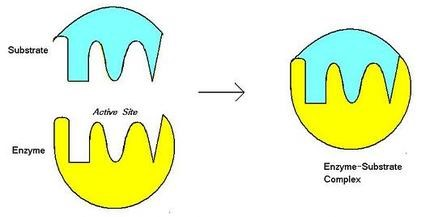
Every enzyme has a specific shape on its surface called the active site. Only one substrate fits into that active site — like a key fits into one specific lock. This is why we call it the lock-and-key model.
How it works, step by step:
- The substrate molecule approaches the enzyme.
- The substrate fits into the active site — they are complementary in shape.
- An enzyme-substrate complex is formed.
- The reaction happens and products are formed.
- The products leave the active site.
- The enzyme is unchanged and ready to work again.
The key word CIE examiners want: complementary. The substrate and active site are complementary in shape — not “the same shape.” That one word difference costs students marks every year.
Enzymes are also described as specific. Each enzyme only works on one type of substrate. Amylase breaks down starch. Protease breaks down proteins. Lipase breaks down fats. They cannot swap jobs because their active sites are different shapes.
Factors Affecting Enzyme Activity — IGCSE
Three main factors affect how well an enzyme works. These come up in almost every CIE IGCSE Biology paper. Know all three deeply.
1. Temperature
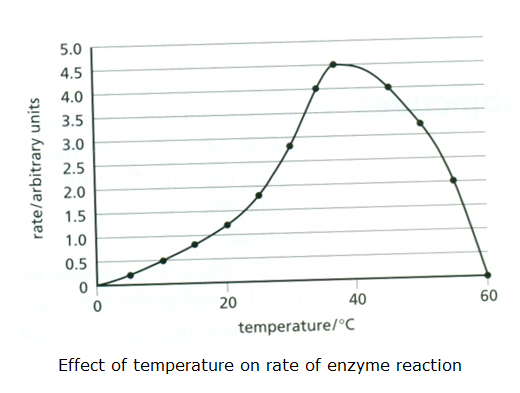
As temperature rises, enzyme activity increases. Molecules move faster and collide more often. More enzyme-substrate complexes form per second.
But there is a limit.
Every enzyme has an optimum temperature — the temperature at which it works fastest. For most human enzymes, this is around 37°C (body temperature).
Above the optimum, the enzyme begins to denature. The heat breaks the bonds holding the enzyme’s shape together. The active site changes shape. The substrate no longer fits. The enzyme cannot be repaired — denaturation is permanent.
What examiners want you to say: Do not write “the enzyme dies.” Enzymes are not alive. Write: “the enzyme denatures and the active site changes shape so the substrate can no longer fit.”
2. pH
Every enzyme also has an optimum pH. At this pH, the enzyme works at its fastest rate. Move too far above or below that pH and enzyme activity drops.
Extreme pH levels break the bonds that hold the enzyme’s shape together. Again, the active site changes shape. The substrate no longer fits. The enzyme is denatured.
Different enzymes have different optimum pH levels:
- Pepsin (stomach enzyme) works best at around pH 2 — very acidic
- Amylase (in saliva) works best at around pH 7 — neutral
- Trypsin (in the small intestine) works best at around pH 8 — slightly alkaline
Exam tip: Always link pH changes back to the active site changing shape. That is the explanation examiners are looking for — not just “the enzyme stops working.”
3. Substrate Concentration
More substrate means more collisions between substrate molecules and enzyme active sites. The rate of reaction increases.
But once all active sites are occupied, adding more substrate makes no difference. The rate levels off. The enzymes are working as fast as they possibly can — this is the maximum rate.
On a graph, this looks like a curve that rises steeply and then flattens out completely. Be ready to explain that flat section. The answer is: all active sites are full and no free active sites are available.
How to Answer Enzyme Graph Questions
Graph questions on enzymes follow a pattern. Once you see the pattern, they become straightforward.
For temperature graphs:
- Rising section → more kinetic energy, more collisions, faster rate
- Peak → optimum temperature
- Falling section → enzyme denaturing, active site changing shape, substrate no longer fits
For pH graphs:
- Rising section → conditions moving toward optimum pH
- Peak → optimum pH for that enzyme
- Falling section → pH too far from optimum, enzyme denaturing
For substrate concentration graphs:
- Rising section → more substrate available, more collisions with active sites
- Flat section → all active sites occupied, enzyme is the limiting factor now
Always describe the shape of the graph first, then explain why using the active site language.
Real IGCSE Exam Questions on Enzymes
Try answering these before reading the model answers.
Question 1 Explain why each enzyme only works on one specific substrate.
Model Answer: Each enzyme has an active site with a unique shape. Only a substrate with a complementary shape can fit into that active site. This is described by the lock-and-key model. Enzymes are therefore specific to their substrate.
Question 2 A student tested enzyme activity at 20°C, 37°C, and 70°C. At 70°C the enzyme stopped working. Explain why.
Model Answer: At 70°C the high temperature caused the enzyme to denature. The bonds holding the enzyme’s shape together broke. The active site changed shape and was no longer complementary to the substrate. The enzyme-substrate complex could not form, so the reaction stopped.
Question 3 Explain what happens to the rate of reaction when substrate concentration is increased beyond a certain point.
Model Answer: Once all the active sites on the enzyme molecules are occupied, the rate of reaction stops increasing. Adding more substrate has no effect because there are no free active sites available. The enzyme concentration is now the limiting factor.
Question 4 Pepsin works in the stomach at pH 2. What would happen if pepsin were placed in the small intestine at pH 8? Explain your answer.
Model Answer: At pH 8, the conditions are far from pepsin’s optimum pH. The bonds holding the enzyme’s shape together would break. The active site would change shape and no longer be complementary to the substrate. Pepsin would denature and stop working.
Question 5 What is the difference between an enzyme being inhibited and an enzyme being denatured?
Model Answer: Inhibition is temporary — removing the inhibitor allows the enzyme to work again. Denaturation is permanent — the active site has changed shape and cannot return to its original form. The enzyme cannot function after denaturation.
Key Words CIE Examiners Want to See
These are the words that separate a 6 from a 9 in enzyme questions. Learn them, use them, repeat them.
- Complementary — the shape of the substrate matches the active site
- Active site — the specific region of the enzyme where the substrate binds
- Enzyme-substrate complex — formed when substrate binds to active site
- Optimum — the condition at which the enzyme works fastest
- Denature — permanent change in enzyme shape due to heat or extreme pH
- Specific — each enzyme only works on one substrate
Do not use: “fits perfectly,” “matches,” “the enzyme dies,” or “the enzyme breaks.” These phrases will not earn you marks.
Who Teaches at BioKatalyst
I am Karishma. My partner Khushbu and I run BioKatalyst together. We have been teaching CIE IGCSE Biology for 13 years — inside Cambridge schools and online. We have won several awards for our teaching.
We teach every student directly. No other tutors. No middlemen. Your child gets us — every session, every week.
We noticed that most students lose enzyme marks not because they do not understand the topic, but because they use the wrong words in their answers. In our one-to-one classes, we go through exactly what to write, how to phrase it, and how to avoid the mistakes that cost marks. We have seen the same errors hundreds of times and we know how to fix them.
Each class is built around your child specifically. If enzymes are the weak spot, that is where we focus. We do not move on until the student can answer any enzyme question with confidence.
Frequently Asked Questions
Do I need to know both the lock-and-key model and the induced fit model for CIE IGCSE? At IGCSE level, CIE only requires the lock-and-key model. The induced fit model is covered at A-Level. Focus fully on lock-and-key for your exams right now.
What is the difference between denaturation and inhibition? Denaturation is permanent — the enzyme’s shape is destroyed and cannot recover. Inhibition is usually temporary — the enzyme can work again once the inhibitor is removed. CIE examiners test this difference directly.
My child keeps writing “the enzyme dies” in answers. Is that wrong? Yes, and it will not earn marks. Enzymes are proteins, not living things. The correct word is denature. In our classes, we drill this language until it becomes automatic.
Which enzymes do I need to know by name for IGCSE Biology? At minimum: amylase (breaks down starch), protease (breaks down proteins), and lipase (breaks down fats). Know what each one does and where in the body it works.
How do I remember the lock-and-key model for the exam? The trick is to understand it rather than just memorise it. In our one-to-one sessions, we build the explanation step by step until your child can write it from memory without thinking. Most students get it fully in one session.
Does BioKatalyst cover the full IGCSE syllabus or just specific topics? We cover the full CIE IGCSE Biology syllabus. We start wherever your child needs help most. Enzymes, photosynthesis, genetics, ecology — all of it. We plan every session around what your child needs that week.
Book a Free Demo Class
Enzyme questions are very scoreable once you know the right words and the right structure. One session with us and your child will know exactly what to write — and what not to write.
Book a free demo class with BioKatalyst today. We will look at exactly where your child is and show them what focused one-to-one teaching feels like.
BioKatalyst — Online Biology Tutors | Taught directly by Karishma & Khushbu | 13 Years Experience | CIE IGCSE Specialists