
What does the IGCSE Biology syllabus 2026–2028 actually cover? Many parents ask this before Grade 9 starts. Here is every topic, paper, and mark split, in simple words.
What Is the IGCSE Biology 0610 Syllabus?
The IGCSE Biology 0610 syllabus is made by Cambridge International. It covers exams in 2026, 2027, and 2028. Exams happen in the June and November series. Most UAE schools teach it in Grades 9 and 10.
Quick facts:
- Code: 0610 (the 9–1 version, 0970, has the same content)
- Total topics: 21
- Exam series: June and November
- Grades: A-star to G
Core or Extended: Which Tier Does Your Child Take?
Core Tier
Core students learn the basic content. They can score grades C to G.
Extended Tier
Extended students learn Core plus extra Supplement content. They can score grades A-star to G.
The school usually picks the tier. Ask early. Revision should match the right level.
IGCSE Biology Syllabus 2026: Exam Papers at a Glance
Every student sits one multiple choice paper, one theory paper, and one practical paper. The school decides between Paper 5 and Paper 6.

| Paper | Tier | Type | Time | Weight |
| Paper 1 | Core | Multiple choice | 45 minutes | 30% |
| Paper 2 | Extended | Multiple choice | 45 minutes | 30% |
| Paper 3 | Core | Theory | 1 hour 15 minutes | 50% |
| Paper 4 | Extended | Theory | 1 hour 15 minutes | 50% |
| Paper 5 | Both | Practical test | 1 hour 15 minutes | 20% |
| Paper 6 | Both | Alternative to practical | 1 hour | 20% |
Theory carries the most marks. So most study time should go there.
All 21 Topics in the IGCSE Biology Syllabus UAE Students Study
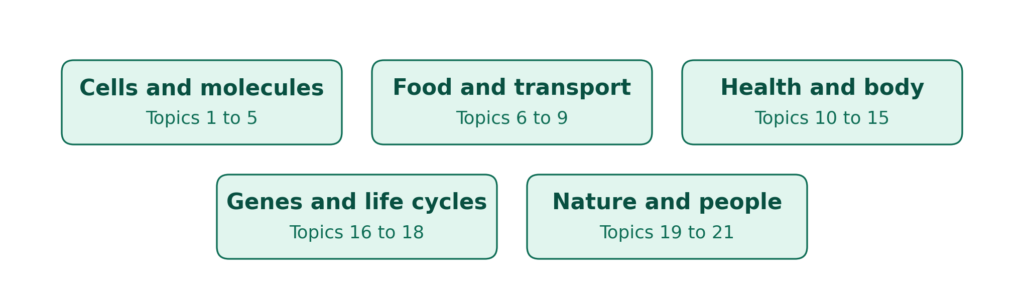
Cells and Molecules
- Characteristics and classification of living organisms: what makes something alive.
- Organisation of the organism: cells, tissues, organs, and using a microscope.
- Movement into and out of cells: diffusion, osmosis, and active transport.
- Biological molecules: carbohydrates, fats, proteins, and food tests.
- Enzymes: how they work, and how heat and pH change them.
Food and Transport
- Plant nutrition: photosynthesis, leaf structure, and minerals plants need.
- Human nutrition: diet, digestion, and how food moves through the gut.
- Transport in plants: water moves through xylem, sugars through phloem.
- Transport in animals: the heart, blood vessels, and blood.
Health and Body Systems
- Diseases and immunity: germs, vaccines, and how the body fights back.
- Gas exchange in humans: lungs, breathing, and the effects of smoking.
- Respiration: aerobic and anaerobic respiration, compared side by side.
- Excretion in humans: the kidneys and how the body removes waste.
- Coordination and response: nerves, hormones, the eye, and body balance.
- Drugs: medicines, antibiotics, and how drug misuse harms the body.
Genes and Life Cycles
- Reproduction: flowers, seeds, and human reproduction.
- Inheritance: DNA, genes, and Punnett squares.
- Variation and selection: natural selection and selective breeding.
Nature and People
- Organisms and their environment: food chains, energy flow, and nutrient cycles.
- Human influences on ecosystems: pollution, deforestation, and protecting nature.
- Biotechnology and genetic modification: yeast, bacteria, and genetic engineering
Genetics and transport topics need extra practice for most students
How to Study the IGCSE Biology Syllabus Step by Step

- Print the topic list. Tick each topic once it is done.
- Learn one topic at a time. Do not rush ahead.
- Solve IGCSE Biology past papers right after each topic.
- Check the mark scheme. Examiners look for exact keywords.
- Do full timed papers in the last two months.
Clear IGCSE Biology notes make this much easier. Keep them short and neat.
Why One-to-One Tuition Helps With the Cambridge IGCSE Biology Syllabus
Big classes move fast. Some children stay quiet when they do not understand. One-to-one classes work differently.
- My child asks doubts freely, without worrying about the class.
- The teacher spots weak topics early and fixes them.
- Lessons move at my child’s own pace.
- I know how my child is doing, week by week.
I am Karishma, founder of Biokatalyst, along with my partner Khushbu. We have 13 years of experience teaching in Cambridge schools and online. We have received several awards for our teaching work. We teach students directly, without any middleman. Every child gets personal attention.
FAQs on the IGCSE Biology Syllabus
What is the IGCSE Biology syllabus code?
The code is 0610. A 9–1 graded version, coded 0970, has the same content.
Is the IGCSE Biology syllabus UAE schools follow different?
No. UAE schools follow the same Cambridge syllabus. Exams run in June and November.
How many topics are in the IGCSE Biology 0610 syllabus?
There are 21 topics. They start with classification of living things. They end with biotechnology and genetic modification.
Is the IGCSE Biology syllabus 2026 hard?
It feels easier when studied topic by topic. Genetics and transport need extra practice.
When should my child start revising?
Start in Grade 9. Revise each topic soon after learning it. Small, regular revision works better than last-minute cramming.
How do past papers help?
They show how questions are asked. They also show which keywords earn marks.
Can one-to-one classes help my child?
Yes. The teacher fixes each gap and moves at your child’s pace. Parents also get regular updates.
Conclusion
The IGCSE Biology syllabus has 21 topics, three papers, and a clear mark split. Knowing this early removes a lot of stress. Your child can plan revision topic by topic.
With one-to-one support, doubts get solved on time. Your child learns at their own pace. You feel supported too.