
You can find our FREE IGCSE BIOLOGY NOTES HERE : IGCSE Biology Notes — The Biokatalyst
1. What is nutrition?
Nutrition is the taking in and use of food substances by an organism. Humans are heterotrophic — they cannot make their own food and must obtain organic nutrients from other organisms (plants and animals).
A balanced diet contains the correct proportions of all nutrients needed for health, in the right amounts for a person’s age, sex, and activity level.
IGCSE Biology Notes: Human Nutrition & Diseases
1. What is nutrition?
Nutrition is the taking in and use of food substances by an organism. Humans are heterotrophic — they cannot make their own food and must obtain organic nutrients from other organisms (plants and animals).
A balanced diet contains the correct proportions of all nutrients needed for health, in the right amounts for a person’s age, sex, and activity level.
2. The seven components of food
| Nutrient | Main function | Good sources | Deficiency disease |
| Carbohydrates | Main energy source | Rice, bread, potatoes, pasta | Weight loss, fatigue |
| Proteins | Growth and repair of tissue; enzymes/antibodies | Meat, fish, eggs, beans, lentils | Kwashiorkor |
| Fats/Lipids | Energy store, insulation, cell membranes | Butter, oils, nuts | Weight loss |
| Vitamin A | Healthy skin, vision (retina pigment) | Liver, carrots, dairy | Night blindness |
| Vitamin C | Connective tissue, wound healing, immunity | Citrus fruit, peppers | Scurvy |
| Vitamin D | Absorption of calcium in the gut | Sunlight on skin, oily fish, eggs | Rickets |
| Calcium | Bones, teeth, blood clotting, nerve/muscle function | Milk, cheese, leafy greens | Weak bones/teeth |
| Iron | Component of haemoglobin | Red meat, spinach, liver | Anaemia |
| Fibre (roughage) | Adds bulk, aids peristalsis, prevents constipation | Wholegrains, fruit, vegetables | Constipation |
| Water | Solvent for reactions, transport, temperature control | Drinks, fruit, vegetables | Dehydration |
Key terms
- Macronutrients: carbohydrates, proteins, fats — needed in large amounts
- Micronutrients: vitamins and minerals — needed in small amounts
3. Food tests
| Test | Reagent | Method | Positive result |
| Reducing sugars | Benedict’s solution | Add and heat in water bath | Brick-red precipitate |
| Starch | Iodine solution | Add drops directly | Blue-black colour |
| Protein | Biuret solution (or NaOH + CuSO₄) | Add at room temperature | Purple/violet colour |
| Fats/lipids | Ethanol (emulsion test) | Mix with ethanol, then add water | Cloudy white emulsion |
4. Diet across life stages
- Children/teenagers: need more protein and calcium for growth
- Pregnant women: extra energy, protein, iron, calcium, and folic acid (reduces risk of neural tube defects)
- Manual workers/athletes: higher energy (carbohydrate) intake
- Elderly: lower energy needs but same vitamin/mineral requirements
5. The human digestive system
Digestion is the breakdown of large, insoluble food molecules into small, soluble molecules that can be absorbed into the blood.
- Mechanical digestion: physical breakdown (chewing, churning in the stomach) — increases surface area
- Chemical digestion: breakdown by enzymes into simpler molecules
Main organs and their roles
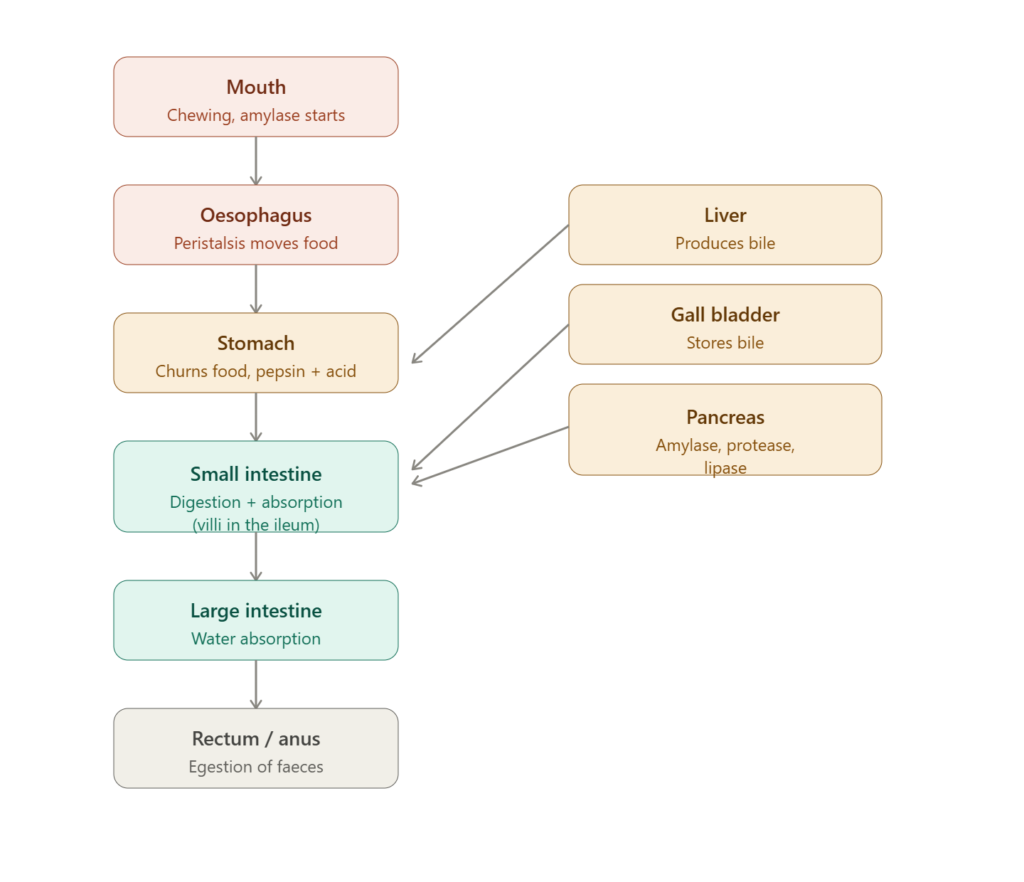
- Mouth: chewing (mechanical); salivary amylase starts starch digestion
- Oesophagus: moves food to stomach by peristalsis
- Stomach: churns food; pepsin digests protein; hydrochloric acid kills bacteria and gives optimum pH for pepsin
- Small intestine (duodenum): receives bile (from liver, stored in gall bladder) which emulsifies fats; receives pancreatic juice (amylase, protease, lipase)
- Small intestine (ileum): final digestion and absorption of nutrients through villi
- Large intestine: absorption of water; formation of faeces
- Rectum/anus: storage and egestion of faeces
6. Enzymes in digestion
Enzymes are biological catalysts (proteins) that speed up chemical reactions without being used up.
| Enzyme | Produced in | Substrate | Product | Optimum condition |
| Amylase | Salivary glands, pancreas | Starch | Maltose | pH 7 (mouth), pH 8 (small intestine) |
| Protease (e.g. pepsin, trypsin) | Stomach, pancreas | Protein | Amino acids | pH 2 (stomach, acidic) |
| Lipase | Pancreas | Fats (lipids) | Fatty acids + glycerol | pH 8 (alkaline, small intestine) |
Bile is not an enzyme — it emulsifies fat (breaks it into small droplets) to increase surface area for lipase, and neutralises stomach acid so enzymes in the small intestine work at their optimum pH.
7. Absorption and assimilation
- Absorption: movement of digested nutrients from the small intestine into the blood/lymph, mainly across the villi in the ileum
- Villi are adapted for absorption by having:
- a large surface area
- a single layer of epithelial cells (short diffusion distance)
- a dense capillary network to carry away glucose and amino acids
- a lacteal (lymph vessel) to absorb fatty acids and glycerol
- Assimilation: the use of absorbed nutrients by cells, e.g. glucose used in respiration, amino acids used to build new proteins
- Egestion: removal of undigested food as faeces through the anus (different from excretion, which removes metabolic waste)
8. Diseases related to nutrition
A. Malnutrition (deficiency diseases)
- Kwashiorkor: protein deficiency — swollen abdomen, poor growth, in children
- Marasmus: severe deficiency of both protein and energy — extreme thinness
- Scurvy: vitamin C deficiency — bleeding gums, poor wound healing
- Rickets: vitamin D/calcium deficiency — soft, weak, bowed bones in children
- Anaemia: iron deficiency — low haemoglobin, tiredness, pale skin
- Constipation: low fibre and water intake — difficulty passing faeces
B. Diseases of excess (over-nutrition)
- Obesity: excess fat storage from energy intake exceeding energy use; linked to type 2 diabetes, heart disease, and joint problems
- Type 2 diabetes: body cells become less responsive to insulin, or insufficient insulin is produced; linked to diet high in sugar/fat and obesity
- Coronary heart disease (CHD): diet high in saturated fat raises blood cholesterol, leading to fatty deposits (atheroma) narrowing the coronary arteries, restricting blood flow to the heart muscle
C. Other diet-related illness
- Diarrhoea: can be caused by pathogens (e.g. cholera bacteria) affecting water absorption in the large intestine, leading to dehydration
9. Quick keyword glossary
Nutrition · Balanced diet · Macronutrient · Micronutrient · Carbohydrate · Protein · Lipid/fat · Vitamin · Mineral · Fibre/roughage · Digestion · Mechanical digestion · Chemical digestion · Peristalsis · Enzyme · Amylase · Protease · Lipase · Bile · Emulsification · Absorption · Villi · Lacteal · Assimilation · Egestion · Kwashiorkor · Marasmus · Scurvy · Rickets · Anaemia · Obesity · Diabetes · Coronary heart disease · Atheroma
Exam tip
When asked to explain villi adaptations or enzyme action, always link structure to function (e.g. “villi have a large surface area, which increases the rate of diffusion of nutrients into the blood”) — IGCSE mark schemes reward the “which increases/allowing” link, not just the feature alone.
2. The seven components of food
| Nutrient | Main function | Good sources | Deficiency disease |
| Carbohydrates | Main energy source | Rice, bread, potatoes, pasta | Weight loss, fatigue |
| Proteins | Growth and repair of tissue; enzymes/antibodies | Meat, fish, eggs, beans, lentils | Kwashiorkor |
| Fats/Lipids | Energy store, insulation, cell membranes | Butter, oils, nuts | Weight loss |
| Vitamin A | Healthy skin, vision (retina pigment) | Liver, carrots, dairy | Night blindness |
| Vitamin C | Connective tissue, wound healing, immunity | Citrus fruit, peppers | Scurvy |
| Vitamin D | Absorption of calcium in the gut | Sunlight on skin, oily fish, eggs | Rickets |
| Calcium | Bones, teeth, blood clotting, nerve/muscle function | Milk, cheese, leafy greens | Weak bones/teeth |
| Iron | Component of haemoglobin | Red meat, spinach, liver | Anaemia |
| Fibre (roughage) | Adds bulk, aids peristalsis, prevents constipation | Wholegrains, fruit, vegetables | Constipation |
| Water | Solvent for reactions, transport, temperature control | Drinks, fruit, vegetables | Dehydration |
Key terms
- Macronutrients: carbohydrates, proteins, fats — needed in large amounts
- Micronutrients: vitamins and minerals — needed in small amounts
3. Food tests
| Test | Reagent | Method | Positive result |
| Reducing sugars | Benedict’s solution | Add and heat in water bath | Brick-red precipitate |
| Starch | Iodine solution | Add drops directly | Blue-black colour |
| Protein | Biuret solution (or NaOH + CuSO₄) | Add at room temperature | Purple/violet colour |
| Fats/lipids | Ethanol (emulsion test) | Mix with ethanol, then add water | Cloudy white emulsion |
4. Diet across life stages
- Children/teenagers: need more protein and calcium for growth
- Pregnant women: extra energy, protein, iron, calcium, and folic acid (reduces risk of neural tube defects)
- Manual workers/athletes: higher energy (carbohydrate) intake
- Elderly: lower energy needs but same vitamin/mineral requirements
5. The human digestive system
Digestion is the breakdown of large, insoluble food molecules into small, soluble molecules that can be absorbed into the blood.
- Mechanical digestion: physical breakdown (chewing, churning in the stomach) — increases surface area
- Chemical digestion: breakdown by enzymes into simpler molecules
Main organs and their roles
- Mouth: chewing (mechanical); salivary amylase starts starch digestion
- Oesophagus: moves food to stomach by peristalsis
- Stomach: churns food; pepsin digests protein; hydrochloric acid kills bacteria and gives optimum pH for pepsin
- Small intestine (duodenum): receives bile (from liver, stored in gall bladder) which emulsifies fats; receives pancreatic juice (amylase, protease, lipase)
- Small intestine (ileum): final digestion and absorption of nutrients through villi
- Large intestine: absorption of water; formation of faeces
- Rectum/anus: storage and egestion of faeces
6. Enzymes in digestion
Enzymes are biological catalysts (proteins) that speed up chemical reactions without being used up.
| Enzyme | Produced in | Substrate | Product | Optimum condition |
| Amylase | Salivary glands, pancreas | Starch | Maltose | pH 7 (mouth), pH 8 (small intestine) |
| Protease (e.g. pepsin, trypsin) | Stomach, pancreas | Protein | Amino acids | pH 2 (stomach, acidic) |
| Lipase | Pancreas | Fats (lipids) | Fatty acids + glycerol | pH 8 (alkaline, small intestine) |
Bile is not an enzyme — it emulsifies fat (breaks it into small droplets) to increase surface area for lipase, and neutralises stomach acid so enzymes in the small intestine work at their optimum pH.
7. Absorption and assimilation
- Absorption: movement of digested nutrients from the small intestine into the blood/lymph, mainly across the villi in the ileum
- Villi are adapted for absorption by having:
- a large surface area
- a single layer of epithelial cells (short diffusion distance)
- a dense capillary network to carry away glucose and amino acids
- a lacteal (lymph vessel) to absorb fatty acids and glycerol
- Assimilation: the use of absorbed nutrients by cells, e.g. glucose used in respiration, amino acids used to build new proteins
- Egestion: removal of undigested food as faeces through the anus (different from excretion, which removes metabolic waste)
8. Diseases related to nutrition
A. Malnutrition (deficiency diseases)
- Kwashiorkor: protein deficiency — swollen abdomen, poor growth, in children
- Marasmus: severe deficiency of both protein and energy — extreme thinness
- Scurvy: vitamin C deficiency — bleeding gums, poor wound healing
- Rickets: vitamin D/calcium deficiency — soft, weak, bowed bones in children
- Anaemia: iron deficiency — low haemoglobin, tiredness, pale skin
- Constipation: low fibre and water intake — difficulty passing faeces
B. Diseases of excess (over-nutrition)
- Obesity: excess fat storage from energy intake exceeding energy use; linked to type 2 diabetes, heart disease, and joint problems
- Type 2 diabetes: body cells become less responsive to insulin, or insufficient insulin is produced; linked to diet high in sugar/fat and obesity
- Coronary heart disease (CHD): diet high in saturated fat raises blood cholesterol, leading to fatty deposits (atheroma) narrowing the coronary arteries, restricting blood flow to the heart muscle
C. Other diet-related illness
- Diarrhoea: can be caused by pathogens (e.g. cholera bacteria) affecting water absorption in the large intestine, leading to dehydration
9. Quick keyword glossary
Nutrition · Balanced diet · Macronutrient · Micronutrient · Carbohydrate · Protein · Lipid/fat · Vitamin · Mineral · Fibre/roughage · Digestion · Mechanical digestion · Chemical digestion · Peristalsis · Enzyme · Amylase · Protease · Lipase · Bile · Emulsification · Absorption · Villi · Lacteal · Assimilation · Egestion · Kwashiorkor · Marasmus · Scurvy · Rickets · Anaemia · Obesity · Diabetes · Coronary heart disease · Atheroma
Exam tip
When asked to explain villi adaptations or enzyme action, always link structure to function (e.g. “villi have a large surface area, which increases the rate of diffusion of nutrients into the blood”) — IGCSE mark schemes reward the “which increases/allowing” link, not just the feature alone.
Need More Info – Contact Us