
What does the Edexcel IGCSE specification for Biology actually cover? Many students never read it. This guide explains every topic of 4BI1 in simple words, so you know exactly what to study.
What Is the Edexcel IGCSE Biology Specification?
The specification is the official list of what you must learn. Think of it as your exam checklist.
Edexcel IGCSE Biology has the code 4BI1. It is made by Pearson. Every exam question comes from this document.
If a point is in the specification, it can be asked. If it is not there, you can skip it.
In my 13 years of teaching, I have seen one thing often. Students who use the specification as a checklist revise smarter. They stop guessing and start ticking off topics.
Exam Format at a Glance
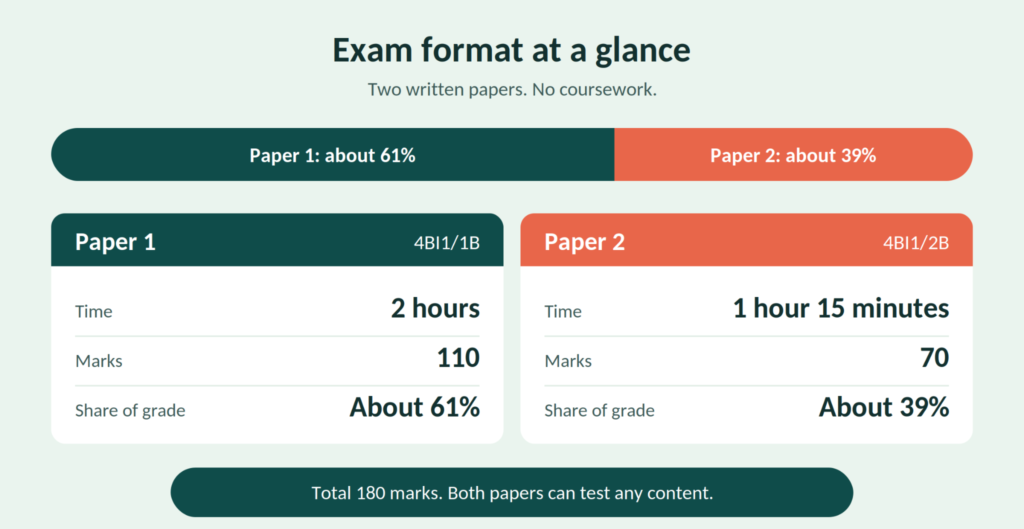
There is no coursework. Your grade comes from two written papers.
| Point | Paper 1 (4BI1/1B) | Paper 2 (4BI1/2B) |
| Time | 2 hours | 1 hour 15 minutes |
| Marks | 110 | 70 |
| Share of grade | About 61% | About 39% |
The total is 180 marks. Both papers can test any part of the content.
Practical skills are not a separate exam. They are tested inside these written papers. So you must know how experiments work, not just the theory.
Edexcel IGCSE Specification Biology: The 5 Main Topics
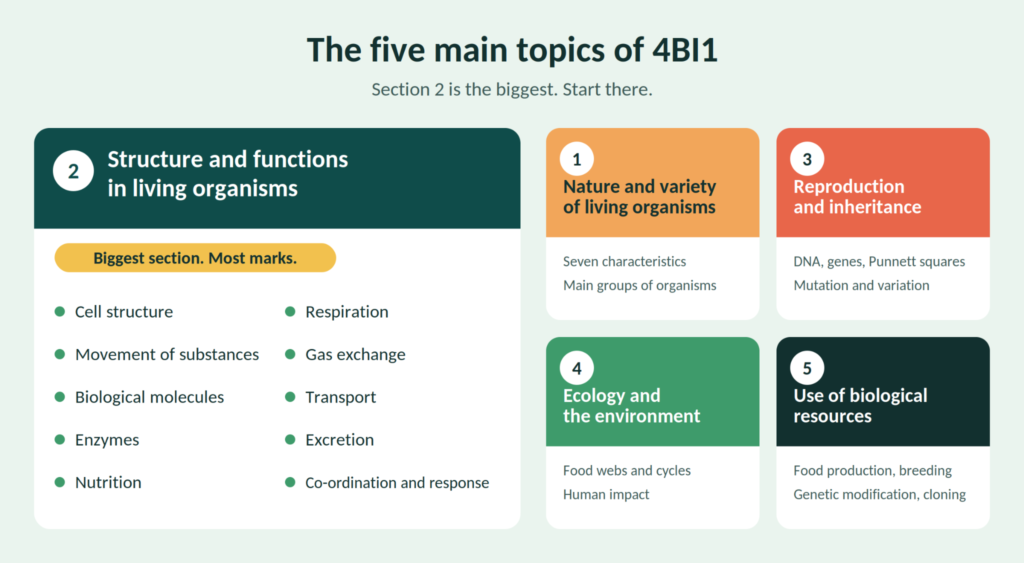
The content is split into five sections. Each section has smaller parts. Here is the full map.
Section 1: The Nature and Variety of Living Organisms
This is where Biology begins. It is a small section, but it builds your base.
You learn:
- The seven characteristics of living things.
- The main groups: plants, animals, fungi, bacteria, protoctists and viruses.
- Key features used to tell these groups apart.
Study tip: Make a simple chart for each group. Add two or three features and one example.
Section 2: Structure and Functions in Living Organisms
This is the biggest section. Most marks come from here.
It has ten parts:
- Cell structure
- Movement of substances (diffusion, osmosis, active transport)
- Biological molecules
- Enzymes
- Nutrition
- Respiration
- Gas exchange
- Transport
- Excretion
- Co-ordination and response
Start with cells and enzymes. Many later topics depend on them.
Study tip: Practise drawing and labelling. Diagrams of the heart, leaf, kidney and eye come up often.
Section 3: Reproduction and Inheritance
This section covers how life continues. It also covers how traits pass on.
You learn:
- Sexual and asexual reproduction in plants and humans.
- DNA, genes and chromosomes.
- Monohybrid crosses and Punnett squares.
- Mutation and variation.
Many students find genetics hard at first. Go slowly. Do small practice crosses every day for a week. The pattern becomes clear fast.
Section 4: Ecology and the Environment
This section is about living things and their surroundings.
It covers:
- How organisms live in their habitats.
- Food chains, food webs and energy flow.
- The carbon and nitrogen cycles.
- How humans affect the environment.
Study tip: Link each topic to real life. Think about pollution, deforestation and climate change. Examiners love these examples.
Section 5: Use of Biological Resources
This is the most practical section. It shows how Biology is used in daily life.
You learn:
- Food production, such as crops and fish farming.
- Selective breeding.
- Genetic modification.
- Cloning.
Expect questions that ask for your opinion. You may need to weigh up good and bad points. Always give a clear reason.
How the Papers Test You
Marks are not only for remembering facts. You are also tested on applying what you know.
Examiners look at three skills:
- Knowing and understanding Biology.
- Using that knowledge in new situations.
- Planning, doing and judging experiments.
So reading notes alone is not enough. You need practice with unfamiliar questions.
Core Practicals You Should Know
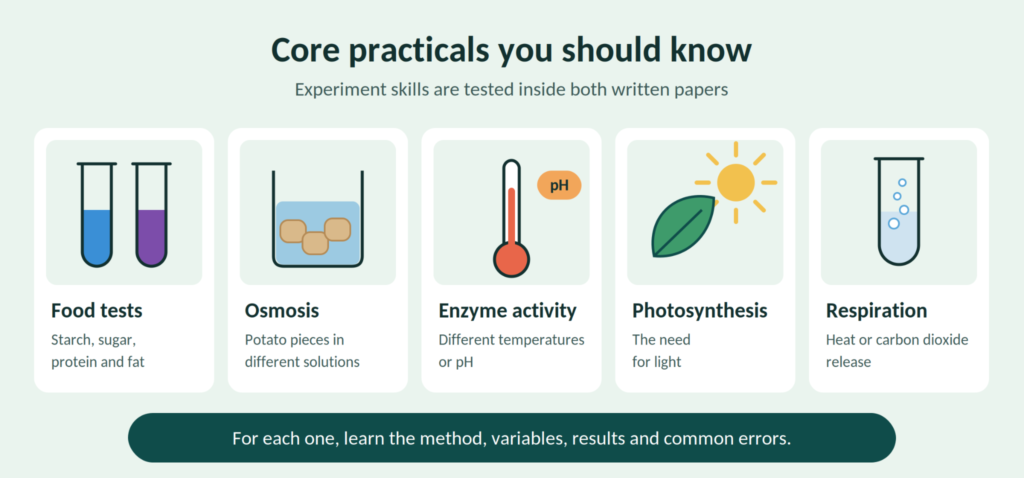
Experiment skills matter in both papers. Be ready for these ideas:
- Testing foods for starch, sugar, protein and fat.
- Osmosis with potato pieces.
- Enzyme activity at different temperatures or pH.
- Photosynthesis and the need for light.
- Respiration and heat or carbon dioxide release.
For each one, learn the method. Then learn the variables, the results and the common errors.
A Simple Way to Use the Specification
Here is a method I share with my own students.
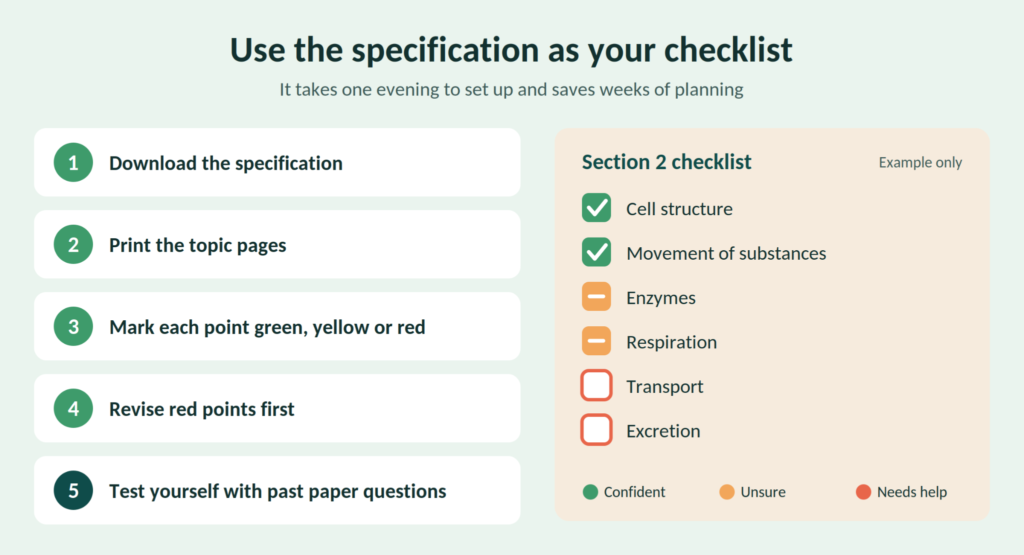
- Download the official specification from the Pearson website.
- Print the topic pages.
- Mark each point as green, yellow or red.
- Green means you are confident. Yellow means you are unsure. Red means you need help.
- Revise red points first.
- Test yourself with past paper questions on each point.
This takes one evening to set up. It saves weeks of unplanned revision.
Common Mistakes Students Make
Watch out for these habits:
- Revising only the topics they like.
- Ignoring the practical skills.
- Learning definitions without understanding them.
- Leaving past papers until the last month.
- Not asking for help when a topic feels confusing.
Doubts grow when they are ignored. Clear them early.
How We Help at Biokatalyst
I am Karishma, founder of Biokatalyst. My partner Khushbu and I have 13 years of experience teaching in Cambridge schools and online. We have also received several awards for our teaching work.
We teach students directly, with no middleman. Every class is one-to-one.
We go through the specification with each student. We find the red topics first. Then we work on them step by step, at the student’s own pace. Parents also get regular updates, so they know how their child is doing.
FAQs
1. What is the Edexcel IGCSE Biology code?
The code is 4BI1. The papers are called 4BI1/1B and 4BI1/2B.
2. How many papers are there in Edexcel IGCSE Biology?
There are two papers. Paper 1 is 2 hours long. Paper 2 is 1 hour 15 minutes long.
3. How many marks is the exam worth?
The total is 180 marks. Paper 1 has 110 marks and Paper 2 has 70.
4. Is there coursework in Edexcel IGCSE Biology?
No. Your grade comes only from the two written papers.
5. Where can I download the specification?
You can download it free from the Pearson Edexcel website. Always use the latest version for your exam year.
6. Which topic carries the most marks?
Section 2 is the largest. It covers cells, enzymes, nutrition, respiration, transport and more.
7. How should I use past papers?
Start after you finish each topic. Try questions first and check the mark scheme next. Note the words examiners expect.
8. Is Edexcel IGCSE Biology harder than Cambridge IGCSE Biology?
Neither is simply harder. They cover similar ideas but the question styles differ. Choose based on your school.
9. Can a tutor help with the specification?
Yes. A good tutor turns the specification into a clear study plan. They also fix weak topics early.
Conclusion
The edexcel igcse specification biology is your map for the whole course. Know the two papers. Learn the five topics. Practise the core experiments. Tick off each point as you go.
When you study with the specification beside you, nothing feels like a surprise.
Not sure where to start? Join a demo class. Meet your online biology tutors first.