
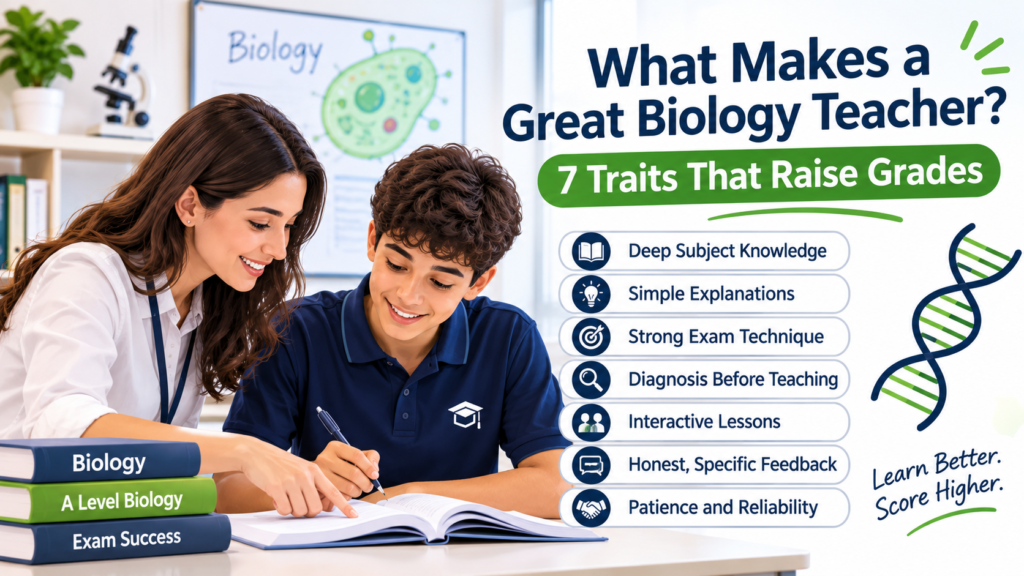
Ask any student who loves science and they can usually name the person who made it click. It was rarely the textbook or the revision guide. It was a teacher who explained a difficult idea in a way that finally made sense, who noticed when they were lost and who made them believe they could succeed. A great biology teacher does far more than cover the syllabus. They change how a student thinks about the living world and about their own ability.
But what exactly separates a great teacher from a merely competent one? After years of watching students improve, or stagnate, the same seven traits keep appearing. Use them as a checklist whether you are a parent choosing support, a student evaluating your current lessons or a new teacher looking to grow.
Why Teaching Quality Matters
Research on education consistently points to teacher quality as one of the strongest school-based influences on student progress. In a subject as layered as biology, the effect is magnified. Concepts build on each other: you cannot understand gene expression without understanding protein structure, and you cannot understand protein structure without understanding chemical bonding. A single weak link in the chain can leave a student confused for months.
Great teaching repairs those links early. It also shapes attitude. Students who feel capable and curious take on harder problems, ask better questions and recover more quickly from setbacks. The seven traits below describe how that happens in practice.
1. Deep Subject Knowledge
Great teachers know far more than the syllabus requires, and that depth shows when a student asks an unexpected question. Why does the heart have a double circulation? Why do some enzymes work best at an acidic pH? Where does the energy in ATP really come from? A teacher with deep knowledge answers confidently, connects the answer to the topic at hand and often turns the curiosity into a mini-lesson that students remember for years.
Depth also helps with accuracy. Simplified explanations are useful, but they must not mislead. A skilled teacher knows exactly where a simplification is safe and where it will cause trouble in later exams, and chooses language accordingly.
2. Simple Explanations for Complex Ideas
Biology is full of processes that look intimidating on paper: the Krebs cycle, the clotting cascade, protein synthesis. Great teachers break them into steps and use analogies that make the abstract concrete. Enzymes become locks and keys, the cell membrane becomes a selective security gate, and mRNA becomes a photocopy of a recipe from a library book that cannot leave the shelf.
Simplicity is not the same as shallowness. The best explanations start simple, then add layers as understanding grows, and always return to the key idea in plain language. A good test is whether a student can explain the topic back to a younger sibling after the lesson.
3. Strong Exam Technique
Understanding biology and scoring marks in biology exams are related, but they are not identical. Great teachers know how mark schemes work, which phrases earn credit and which common answers are too vague. They teach students to read command words carefully, match the length of an answer to the marks available and avoid writing everything they know about a topic when the question asks for something specific.
This matters enormously in A Level Biology, where the same knowledge can earn very different marks depending on how it is written. A student who writes ‘the enzyme gets damaged’ may earn nothing, while one who writes ‘the high temperature breaks hydrogen bonds, changing the tertiary structure and the shape of the active site’ earns every mark. Teachers who train this precision, with regular past paper practice and careful marking, give their students a measurable advantage.
4. Diagnosis Before Teaching
Great teachers do not assume. They find out what a student actually understands before moving on. They ask probing questions, check homework for patterns, use quick quizzes and listen closely to how students phrase their explanations, because the wording often reveals the misconception. A student who says ‘plants breathe in carbon dioxide’ is mixing up respiration and photosynthesis, and the teacher who notices can fix it in minutes.
This diagnostic habit saves time. Instead of reteaching everything, the teacher targets the exact gap. Students feel understood rather than lectured at, and progress accelerates because every minute of the lesson addresses a real need.
5. Interactive, Active Lessons
Passive listening produces weak learning. Great teachers keep students thinking by asking questions, inviting predictions, drawing diagrams together and presenting problems to solve. A lesson on osmosis might begin with a puzzle, such as why a slug shrivels when salt is poured on it, before the theory is introduced. Students attempt an answer, discuss it and then see the science that explains it.
Online or in person, the principle is the same: the student should be doing at least as much thinking, speaking and writing as the teacher. Lessons that feel like conversations stick far better than those that feel like lectures.
6. Honest, Specific Feedback
‘Be more detailed’ is nearly useless. ‘Add the name of the enzyme and the product it forms’ earns marks next time. Great teachers give feedback that points to a specific change, explains why it matters and offers a chance to try again. They praise what is working so students know what to keep, and they are honest about what is not, without damaging confidence.
Good feedback is also timely. Marked work that comes back three weeks later has little impact, while feedback within a day or two connects directly to what the student was thinking. Regular, small corrections beat occasional large ones.
7. Patience and Reliability
Students learn best when they feel safe to be wrong. Great teachers respond to mistakes with curiosity rather than irritation, give students time to think and repeat explanations as many times as necessary, in new ways each time. They are also dependable. They arrive on time, prepare properly, follow through on promises and communicate clearly with parents.
These qualities may seem ordinary, but they build trust, and trust is the foundation of everything else. A student who trusts a teacher asks the awkward question, admits confusion early and works harder on difficult topics because they believe the effort will pay off.
What a Great 60-Minute Lesson Looks Like
Imagine a session on the nervous system. It opens with five minutes of retrieval: quick questions on last week’s topic, answered from memory. The teacher then introduces a puzzle, perhaps why touching a hot pan makes you pull your hand away before you feel pain. Ten minutes of explanation follow, built around a clear diagram of the reflex arc that the student draws and labels during the discussion.
Next comes twenty minutes of practice. The student answers three exam-style questions of increasing difficulty while the teacher watches, asks prompting questions and notes any hesitation. The teacher then goes through the answers, linking each correction to the mark scheme. The last ten minutes are a summary, where the student explains the topic in their own words, followed by a short task for the week.
Notice what the lesson does not include: long stretches of one-way talking, copying notes from slides or unchecked homework. Every activity has a purpose, from the first retrieval question to the final summary, and the student is working throughout. Nothing is wasted, and the student leaves knowing exactly what they learned.
Qualities That Sound Impressive but Matter Less
Some features look good on a profile but say little about teaching quality. A long list of certificates does not guarantee the ability to explain. Years of experience help, but only if the person has reflected and improved rather than repeating the same lessons. Expensive resources and polished slides cannot replace good questioning. Even excellent personal exam results do not automatically translate into skill at teaching others. Prioritise the traits above, and treat credentials as a useful starting point rather than the full story.
Signs It May Be Time for a Change
Not every pairing works. Warning signs include a student who dreads lessons, grades that stay flat after two or three months, feedback that is vague or absent, repeated lateness or cancellations, and explanations that leave the student more confused than before. If you notice these patterns, raise them politely with the teacher first. A good professional welcomes feedback and adjusts. If nothing changes, look elsewhere; the right fit can transform results, and a poor fit wastes precious time before exams.
Where to Find the Right One
Parents searching for tutors in Dubai often shortlist by price, proximity or the loudest advertising. A better approach is to look for evidence. Check qualifications and subject specialism, ask about experience with your child’s exam board and request a free trial lesson. Read parent reviews with an eye for specifics, such as ‘my daughter went from a C to an A’ or ‘she finally understands genetics’, rather than generic praise.
Pay attention to communication from the first message. A prompt, clear and thoughtful reply suggests a professional who will also communicate well during the year. Finally, ask your child for their view after the trial. Students are often the best judges of whether a teacher’s style works for them.
How Students Can Get the Most From Any Teacher
Even the best teaching works better when students contribute. Arrive with specific questions, rather than a vague ‘I don’t get it’. Complete set work honestly, because mistakes are useful information. Ask for explanations in different ways when something does not click, and do not pretend to understand. Review notes within 24 hours of a lesson, when memory is strongest. A student who treats lessons as a partnership usually progresses far faster than one who treats them as a performance.
Final Thoughts
The right biology teacher can turn a dreaded subject into a favourite one, and make A Level Biology feel manageable instead of overwhelming. Look for deep knowledge, clear explanations, exam precision, careful diagnosis, active lessons, honest feedback and genuine patience. No one is perfect at all seven every day, but great teachers consistently aim for them.
As you compare tutors in Dubai or explore online options, choose the person who makes your child curious, not just prepared. Marks follow understanding, and understanding follows interest. Book a free demo class with The BioKatalyst to experience this kind of teaching first-hand and see how it feels for your child.
FAQs
How do I know if my child’s biology teacher is effective?
Look for rising confidence, better exam answers and a child who can explain topics back to you in their own words. Regular test results and specific feedback are also strong indicators.
Do tutors in Dubai offer trial classes?
Many do. A free demo is the best way to judge teaching style, communication and fit before you commit, so always ask about it before booking.
Does A Level Biology need a subject specialist?
Ideally yes. The depth of content, the data analysis and the long-answer questions all benefit from a teacher who knows the specification and mark schemes in detail.
Can a great teacher make up for weak foundations?
Yes, though it takes time. A good teacher diagnoses missing knowledge, rebuilds it step by step and keeps connecting it to current topics so confidence returns steadily.